


Hyacinth Macaw
Anodorhynchus hyacinthinus
- KingdomAnimalia (Animals)
- PhylumChordata (Cordats)
- ClassAves (Aus)
- OrderPsittaciformes (Parrots)
- FamilyPsittacidae (New World and African Parrots)
- GenusAnodorhynchus (Blue Macaws)
- SpeciesAnodorhynchus hyacinthinus (Hyacinth Macaw)
The hyacinth macaw (Anodorhynchus hyacinthinus), or hyacinthine macaw, is a parrot native to central and eastern South America. With a length (from the top of its head to the tip of its long pointed tail) of about one meter it is longer than any other species of parrot. It is the largest macaw and the largest flying parrot species. While generally easily recognized, it could be confused with the smaller Lear's macaw. Habitat loss and the trapping of wild birds for the pet trade have taken a heavy toll on their population in the wild, so the species is classified as Vulnerable on the International Union for Conservation of Nature's Red List, and it is protected by its listing on Appendix I of the Convention on International Trade in Endangered Species of Wild Fauna and Flora (CITES). Wikipedia →
Closest Relatives at Emas National Park
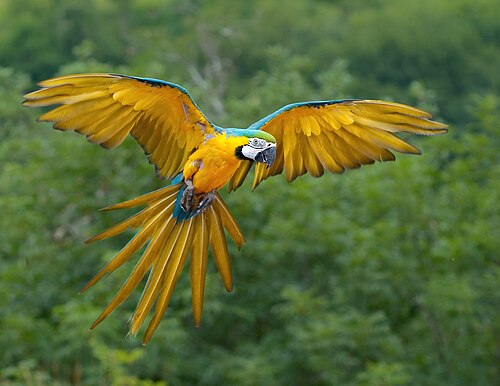
Blue-and-yellow Macaw
Ara ararauna

Peach-fronted Parakeet
Aratinga aurea

Yellow-faced Parrot
Amazona xanthops

Blue-fronted Parrot
Amazona aestiva

Red-shouldered Macaw
Diopsittaca nobilis

Yellow-chevroned Parakeet
Brotogeris chiriri

Blue-winged Macaw
Primolius maracana

White-eyed Parakeet
Aratinga leucophthalma

Blue-headed Parrot
Pionus menstruus

Orange-winged Parrot
Amazona amazonica

Scaly-headed Parrot
Pionus maximiliani

Yellow-collared Macaw
Primolius auricollis
📅 Monthly Probability
Fewer than 5 records of Hyacinth Macaw at Emas National Park — not enough to chart months honestly.
☀️ When They're Spotted
Most active during daytime hours (6am–6pm) · across all parks (global)
Global Distribution
Where this species is recorded worldwide. Restricted to human observations from 2019 onwards — the same kind of record and the same period the probabilities on this page are built from, so collar-tracking studies, camera-trap arrays and museum specimens are excluded. Around Santa Rosa that removes 5,924 GPS fixes from a handful of tagged jaguars.
where this species is recorded (GBIF density — it tracks where observers go, not how likely a sighting is) · parks where it occurs — tap a pin for the sighting probability there
Parks Where Found
| # | Park | Country | Probability |
|---|---|---|---|
| 1 | Parque Estadual Encontro das Águas | 🇧🇷 Brazil | |
| 2 | Iguazú National Park | 🇦🇷 Argentina | |
| 3 | Emas National Park | 🇧🇷 Brazil | |
| 4 | Chapada dos Guimarães National Park | 🇧🇷 Brazil |