


Greater Earless Lizard
Cophosaurus texanus
- KingdomAnimalia (Animals)
- PhylumChordata (Cordats)
- ClassSquamata
- FamilyPhrynosomatidae (Frinosomàtids)
- GenusCophosaurus
- SpeciesCophosaurus texanus (Greater Earless Lizard)
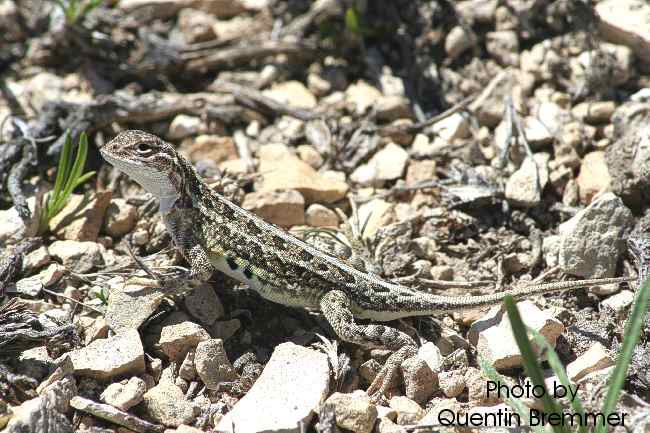
The greater earless lizard (Cophosaurus texanus) is the only species in the monotypic genus Cophosaurus. It is closely related to the smaller, lesser earless lizards and other species in the genus Holbrookia, and in fact was placed in that genus and referred to Holbrookia texana from 1852 into the 1970s. Earless lizards lack external ear openings, an adaptation to burrowing in the sand, as are the recessed lower jaw and flared upper labial scales. Greater earless lizards are sexually dimorphic, males grow larger and are more colorful than females, exhibiting pink and green colors that are particularly bright in the breeding season. Two bold black bars mark the lateral region of males but are greatly reduced and vague, or occasionally entirely absent in females. The greater earless lizard is native to the Chihuahua Desert and other arid and semi-arid regions of Southwestern United States and northern Mexico, where they most often occupy moderately open areas of sparse vegetation with rocks, gravel, and sand. Wikipedia →
70–80% of wildlife watchers report a Greater Earless Lizard sighting in Guadalupe Mountains National Park, based on 136 days of visitor records from GBIF citizen-science data.
Closest Relatives at Guadalupe Mountains National Park

Southwestern Fence Lizard
Sceloporus cowlesi

Ornate Tree Lizard
Urosaurus ornatus

Crevice Spiny Lizard
Sceloporus poinsettii

Roundtail Horned Lizard
Phrynosoma modestum

Texas Horned Lizard
Phrynosoma cornutum

Greater Short-horned Lizard
Phrynosoma hernandesi

Common Side-blotched Lizard
Uta stansburiana
Western Earless Lizard
Holbrookia maculata
📅 Monthly Probability
☀️ When They're Spotted
Most active during daytime hours (6am–6pm) · across all parks (global)
Global Distribution
Where this species is recorded worldwide. Restricted to human observations from 2019 onwards — the same kind of record and the same period the probabilities on this page are built from, so collar-tracking studies, camera-trap arrays and museum specimens are excluded. Around Santa Rosa that removes 5,924 GPS fixes from a handful of tagged jaguars.
where this species is recorded (GBIF density — it tracks where observers go, not how likely a sighting is) · parks where it occurs — tap a pin for the sighting probability there
Parks Where Found
| # | Park | Country | Probability |
|---|---|---|---|
| 1 | Guadalupe Mountains National Park | 🇺🇸 United States | |
| 2 | Big Bend National Park | 🇺🇸 United States | |
| 3 | Cumbres de Monterrey National Park | 🇲🇽 Mexico |
Quick answers
What are the chances of seeing a Greater Earless Lizard in Guadalupe Mountains National Park?
About 72% of wildlife watchers report a Greater Earless Lizard sighting in Guadalupe Mountains National Park, based on 136 days of visitor records from GBIF citizen-science data.
When is the best time to see Greater Earless Lizard in Guadalupe Mountains National Park?
September has the highest sighting rate for Greater Earless Lizard in Guadalupe Mountains National Park in our monthly data.