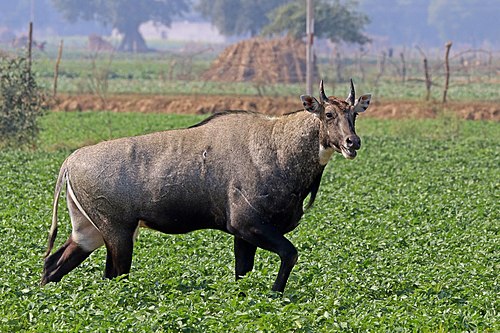


Nilgai
Boselaphus tragocamelus
- KingdomAnimalia (Animals)
- PhylumChordata (Cordats)
- ClassMammalia (Mamífers)
- OrderArtiodactyla (Artiodàctils)
- FamilyBovidae (Bòvids)
- GenusBoselaphus (Nilgais)
- SpeciesBoselaphus tragocamelus (Nilgai)
The nilgai (Boselaphus tragocamelus) (, literally meaning "blue cow") is the largest antelope in Asia. It is ubiquitous across the northern Indian subcontinent. It is the sole living member of the genus Boselaphus, which was first scientifically described by Peter Simon Pallas in 1766. It is a sturdy, thin-legged antelope with a sloping back, a deep neck with a white patch on the throat, a short crest of hair along the neck terminating in a tuft, and white facial spots. A column of pendant, coarse hair hangs from the dewlap ridge below the white patch. It stands 100–150 cm (39–59 in) at the shoulder; males weigh 109–288 kg (240–635 lb), and the lighter females 100–213 kg (220–470 lb). Wikipedia →
70–80% of wildlife watchers report a Nilgai sighting in Ranthambore National Park, based on 83 days of visitor records from GBIF citizen-science data.
Closest Relatives at Ranthambore National Park


📅 Monthly Probability
🌅 When They're Spotted
Most active at dawn and dusk · across all parks (global)
Global Distribution
Where this species is recorded worldwide. Restricted to human observations from 2019 onwards — the same kind of record and the same period the probabilities on this page are built from, so collar-tracking studies, camera-trap arrays and museum specimens are excluded. Around Santa Rosa that removes 5,924 GPS fixes from a handful of tagged jaguars.
where this species is recorded (GBIF density — it tracks where observers go, not how likely a sighting is) · parks where it occurs — tap a pin for the sighting probability there
Parks Where Found
| # | Park | Country | Probability |
|---|---|---|---|
| 1 | Keoladeo National Park | 🇮🇳 India | |
| 2 | Ranthambore National Park | 🇮🇳 India | |
| 3 | Bandhavgarh National Park | 🇮🇳 India | |
| 4 | Satpura National Park | 🇮🇳 India | |
| 5 | Kanha National Park | 🇮🇳 India |
Quick answers
What are the chances of seeing a Nilgai in Ranthambore National Park?
About 70% of wildlife watchers report a Nilgai sighting in Ranthambore National Park, based on 83 days of visitor records from GBIF citizen-science data.
When is the best time to see Nilgai in Ranthambore National Park?
July has the highest sighting rate for Nilgai in Ranthambore National Park in our monthly data.