


Mexican Burrowing Toad
Rhinophrynus dorsalis
- KingdomAnimalia (Animals)
- PhylumChordata (Cordats)
- ClassAmphibia (Amfibis)
- OrderAnura (Anurs)
- FamilyRhinophrynidae (Mexican burrowing toads)
- GenusRhinophrynus (Mexican Burrowing Toads)
- SpeciesRhinophrynus dorsalis (Mexican Burrowing Toad)
The Mexican burrowing toad (Rhinophrynus dorsalis) is the single living representative of the family Rhinophrynidae. It is a unique species in its taxonomy and morphology, with special adaptations to assist them in digging burrows where they spend most of their time. These adaptations include a small pointed snout and face, keratinized structures and a lack of webbing on front limbs, and specialized tongue morphology to assist in feeding on ants and termites underground. The body is nearly equal in width and length. It is a dark brown to black color with a red-orange stripe on its back along with splotches of color on its body. The generic name Rhinophrynus means 'nose-toad', from rhino- (ῥῑνο-), the combining form of the Ancient Greek rhis (ῥίς, 'nose') and phrunē (φρύνη, 'toad'). Wikipedia →
Closest Relatives at Cockscomb Basin Wildlife Sanctuary

Central American Gulf Coast Toad
Incilius valliceps

Giant Marine Toad
Rhinella horribilis

Mexican Smilisca
Smilisca baudinii

Yellow Treefrog
Dendropsophus microcephalus

Long-Legged Streamfrog
Craugastor sabrinus

Vaillant's Frog
Lithobates vaillanti
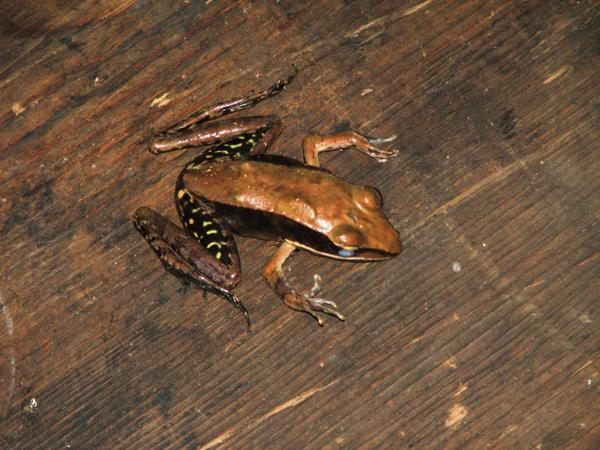
Julian's Frog
Lithobates juliani

Stauffer's Tree Frog
Scinax staufferi

Elegant Narrow-mouthed Toad
Gastrophryne elegans

Harlequin Treefrog
Dendropsophus ebraccatus

Chac's Rainfrog
Craugastor chac

Blue-spotted Mexican Tree Frog
Smilisca cyanosticta
📅 Monthly Probability
Fewer than 5 records of Mexican Burrowing Toad at Cockscomb Basin Wildlife Sanctuary — not enough to chart months honestly.
☀️🌙 When They're Spotted
Active throughout day and night · across all parks (global)
Global Distribution
Where this species is recorded worldwide. Restricted to human observations from 2019 onwards — the same kind of record and the same period the probabilities on this page are built from, so collar-tracking studies, camera-trap arrays and museum specimens are excluded. Around Santa Rosa that removes 5,924 GPS fixes from a handful of tagged jaguars.
where this species is recorded (GBIF density — it tracks where observers go, not how likely a sighting is) · parks where it occurs — tap a pin for the sighting probability there
Parks Where Found
| # | Park | Country | Probability |
|---|---|---|---|
| 1 | Palo Verde National Park | 🇨🇷 Costa Rica | |
| 2 | Calakmul Biosphere Reserve | 🇲🇽 Mexico | |
| 3 | Santa Rosa National Park | 🇨🇷 Costa Rica | |
| 4 | Biotopo Cerro Cahuí | 🇬🇹 Guatemala | |
| 5 | Cockscomb Basin Wildlife Sanctuary | 🇧🇿 Belize | |
| 6 | Sian Ka'an Biosphere Reserve | 🇲🇽 Mexico | |
| 7 | Montes Azules Biosphere Reserve | 🇲🇽 Mexico | |
| 8 | Cumbres de Monterrey National Park | 🇲🇽 Mexico |