
Meves's Glossy-starling
Lamprotornis mevesii
- KingdomAnimalia (Animals)
- PhylumChordata (Cordats)
- ClassAves (Aus)
- OrderPasseriformes
- FamilySturnidae (Starlings)
- GenusLamprotornis (Glossy Starlings and Allies)
- SpeciesLamprotornis mevesii (Meves's Glossy-starling)
Meves's starling (Lamprotornis mevesii), also Meves's glossy starling and Long-tailed starling, is a species of starling in the genus Lamprotornis. It is found in Angola, Botswana, Malawi, Mozambique, Namibia, South Africa, Zambia, and Zimbabwe. Its English and Latin names commemorate the German ornithologist Friedrich Wilhelm Meves. It is 30–36 cm long, with a very long tail; in dull light coloured black, but in bright light, with moderate to intensely strong iridescent gloss. It can be distinguished from the similar Burchell's starling by its longer tail with strongly graduated feathers (the central pair of tail feathers the longest, with subsequent pairs of feathers shorter to the outermost), and from other long-tailed species of Lamprotornis by its dark eyes. Three subspecies are accepted: Lamprotornis mevesii benguelensis Shelley, 1906 — southwestern Angola (Angola Escarpment). Wikipedia →
60–70% of wildlife watchers report a Meves's Glossy-starling sighting in Lower Zambezi National Park, based on 151 days of visitor records from GBIF citizen-science data.
Closest Relatives at Lower Zambezi National Park

Greater Blue-eared Starling
Lamprotornis chalybaeus

Wattled Starling
Creatophora cinerea

Red-winged Starling
Onychognathus morio
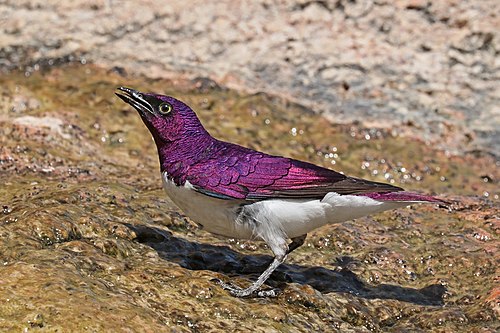
Violet-backed Starling
Cinnyricinclus leucogaster

Fork-tailed Drongo
Dicrurus adsimilis

Common Bulbul
Pycnonotus barbatus

African Pied Wagtail
Motacilla aguimp

Wire-tailed Swallow
Hirundo smithii

Blue-breasted Cordonbleu
Uraeginthus angolensis

Tropical Boubou
Laniarius major

White-crested Helmetshrike
Prionops plumatus

Red-billed Oxpecker
Buphagus erythrorhynchus
📅 Monthly Probability
☀️ When They're Spotted
Most active during daytime hours (6am–6pm) · across all parks (global)
Global Distribution
Where this species is recorded worldwide. Restricted to human observations from 2019 onwards — the same kind of record and the same period the probabilities on this page are built from, so collar-tracking studies, camera-trap arrays and museum specimens are excluded. Around Santa Rosa that removes 5,924 GPS fixes from a handful of tagged jaguars.
where this species is recorded (GBIF density — it tracks where observers go, not how likely a sighting is) · parks where it occurs — tap a pin for the sighting probability there
Parks Where Found
| # | Park | Country | Probability |
|---|---|---|---|
| 1 | Liwonde National Park | 🇲🇼 Malawi | |
| 2 | Gonarezhou National Park | 🇿🇼 Zimbabwe | |
| 3 | Mana Pools National Park | 🇿🇼 Zimbabwe | |
| 4 | Lower Zambezi National Park | 🇿🇲 Zambia | |
| 5 | South Luangwa National Park | 🇿🇲 Zambia | |
| 6 | Moremi Game Reserve | 🇧🇼 Botswana | |
| 7 | Hwange National Park | 🇿🇼 Zimbabwe | |
| 8 | Chobe National Park | 🇧🇼 Botswana | |
| 9 | Kafue National Park | 🇿🇲 Zambia | |
| 10 | Kruger National Park | 🇿🇦 South Africa | |
| 11 | Etosha National Park | 🇳🇦 Namibia |
Quick answers
What are the chances of seeing a Meves's Glossy-starling in Lower Zambezi National Park?
About 68% of wildlife watchers report a Meves's Glossy-starling sighting in Lower Zambezi National Park, based on 151 days of visitor records from GBIF citizen-science data.
When is the best time to see Meves's Glossy-starling in Lower Zambezi National Park?
April has the highest sighting rate for Meves's Glossy-starling in Lower Zambezi National Park in our monthly data.