


Common Reed Frog
Hyperolius viridiflavus
- KingdomAnimalia (Animals)
- PhylumChordata (Cordats)
- ClassAmphibia (Amfibis)
- OrderAnura (Anurs)
- FamilyHyperoliidae (African Reed Frogs)
- GenusHyperolius (Reed Frogs)
- SpeciesHyperolius viridiflavus (Common Reed Frog)
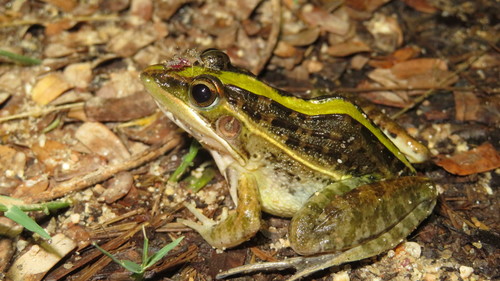
The common reed frog (Hyperolius viridiflavus) is a species of tree frogs in the family Hyperoliidae found in Burundi, the Democratic Republic of the Congo, Ethiopia, Kenya, Rwanda, Sudan, Tanzania, and Uganda, and possibly the Central African Republic, Chad, and Eritrea. Its natural habitats are subtropical or tropical dry forest, subtropical or tropical moist lowland forest, subtropical or tropical moist montane forest, dry savanna, moist savanna, subtropical or tropical dry shrubland, subtropical or tropical moist shrubland, subtropical or tropical seasonally wet or flooded lowland grassland, subtropical or tropical high-altitude grassland, rivers, swamps, freshwater lakes, intermittent freshwater lakes, freshwater marshes, intermittent freshwater marshes, freshwater springs, arable land, pastureland, rural gardens, urban areas, heavily degraded former forests, water storage areas, ponds, irrigated land, seasonally flooded agricultural land, and canals and ditches. The common reed frog is particularly thrifty at rationing out its moisture to maintain long, dry periods during the extended dry seasons in West Africa. It does so by a combination of anuria and increasing its ability to intake water. Fluids contained in its bladder can be used when water becomes unavailable, and the increase in uptake allows it to replenish its stores quickly when the weather allows. Some evidence suggests that west African frogs may change sex from female to male after having successfully bred. Wikipedia →
20–30% of wildlife watchers report a Common Reed Frog sighting in Akagera National Park, based on 5 days of visitor records from GBIF citizen-science data.
Closest Relatives at Akagera National Park


📅 Monthly Probability
☀️🌙 When They're Spotted
Active throughout day and night · across all parks (global)
Global Distribution
Where this species is recorded worldwide. Restricted to human observations from 2019 onwards — the same kind of record and the same period the probabilities on this page are built from, so collar-tracking studies, camera-trap arrays and museum specimens are excluded. Around Santa Rosa that removes 5,924 GPS fixes from a handful of tagged jaguars.
where this species is recorded (GBIF density — it tracks where observers go, not how likely a sighting is) · parks where it occurs — tap a pin for the sighting probability there
Parks Where Found
| # | Park | Country | Probability |
|---|---|---|---|
| 1 | Akagera National Park | 🇷🇼 Rwanda | |
| 2 | Kibale National Park | 🇺🇬 Uganda | |
| 3 | Nairobi National Park | 🇰🇪 Kenya | |
| 4 | Masai Mara National Reserve | 🇰🇪 Kenya | |
| 5 | Virunga National Park | 🇨🇩 Democratic Republic of the Congo | |
| 6 | Arusha National Park | 🇹🇿 Tanzania | |
| 7 | Meru National Park | 🇰🇪 Kenya | |
| 8 | Volcanoes National Park | 🇷🇼 Rwanda | |
| 9 | Lake Nakuru National Park | 🇰🇪 Kenya | |
| 10 | Queen Elizabeth National Park | 🇺🇬 Uganda | |
| 11 | Serengeti National Park | 🇹🇿 Tanzania | |
| 12 | Ngorongoro Conservation Area | 🇹🇿 Tanzania |
Quick answers
What are the chances of seeing a Common Reed Frog in Akagera National Park?
About 23% of wildlife watchers report a Common Reed Frog sighting in Akagera National Park, based on 5 days of visitor records from GBIF citizen-science data.
When is the best time to see Common Reed Frog in Akagera National Park?
December has the highest sighting rate for Common Reed Frog in Akagera National Park in our monthly data.