


Black Catbird
Melanoptila glabrirostris
- KingdomAnimalia (Animals)
- PhylumChordata (Cordats)
- ClassAves (Aus)
- OrderPasseriformes
- FamilyMimidae (Mímids)
- GenusMelanoptila
- SpeciesMelanoptila glabrirostris (Black Catbird)
The black catbird (Melanoptila glabrirostris) is a songbird species in the monotypic genus Melanoptila, part of the family Mimidae. At 19–20.5 cm (7.5–8.1 in) in length and 31.6–42 g (1.11–1.48 oz) in mass, it is the smallest of the mimids. Sexes appear similar, with glossy black plumage, black legs and bill, and dark brownish eyes. The species is endemic to the Yucatán Peninsula, and is found as far south as Campeche, northern Guatemala and northern Belize. Although there are historical records from Honduras and the US state of Texas, the species is not now known to occur in either location. It is found at low elevations in semi-arid to humid habitats ranging from shrubland and abandoned farmland to woodland with thick understory, and is primarily sedentary. Wikipedia →
<5% of wildlife watchers report a Black Catbird sighting in Calakmul Biosphere Reserve, based on 34 days of visitor records from GBIF citizen-science data.
Closest Relatives at Calakmul Biosphere Reserve
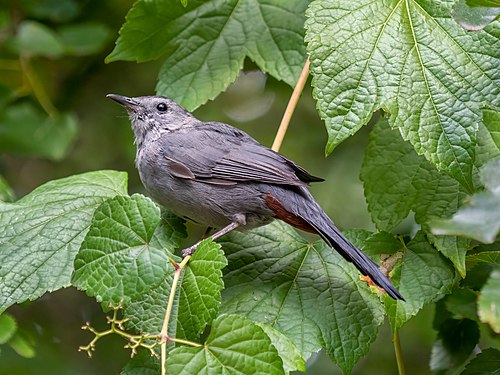
Gray Catbird
Dumetella carolinensis

Tropical Mockingbird
Mimus gilvus

Brown Jay
Psilorhinus morio

Magnolia Warbler
Setophaga magnolia

Social Flycatcher
Myiozetetes similis

White-eyed Vireo
Vireo griseus

Clay-colored Thrush
Turdus grayi

Black-and-white Warbler
Mniotilta varia

Melodious Blackbird
Dives dives

American Redstart
Setophaga ruticilla

Spot-breasted Wren
Pheugopedius maculipectus

Ivory-billed Woodcreeper
Xiphorhynchus flavigaster
📅 Monthly Probability
☀️ When They're Spotted
Most active during daytime hours (6am–6pm) · across all parks (global)
Global Distribution
Where this species is recorded worldwide. Restricted to human observations from 2019 onwards — the same kind of record and the same period the probabilities on this page are built from, so collar-tracking studies, camera-trap arrays and museum specimens are excluded. Around Santa Rosa that removes 5,924 GPS fixes from a handful of tagged jaguars.
where this species is recorded (GBIF density — it tracks where observers go, not how likely a sighting is) · parks where it occurs — tap a pin for the sighting probability there
Parks Where Found
| # | Park | Country | Probability |
|---|---|---|---|
| 1 | Arrecifes de Cozumel National Park | 🇲🇽 Mexico | |
| 2 | Sian Ka'an Biosphere Reserve | 🇲🇽 Mexico | |
| 3 | Calakmul Biosphere Reserve | 🇲🇽 Mexico | |
| 4 | Ría Lagartos Biosphere Reserve | 🇲🇽 Mexico | |
| 5 | Celestún Biosphere Reserve | 🇲🇽 Mexico | |
| 6 | Montes Azules Biosphere Reserve | 🇲🇽 Mexico |
Quick answers
What are the chances of seeing a Black Catbird in Calakmul Biosphere Reserve?
About 4% of wildlife watchers report a Black Catbird sighting in Calakmul Biosphere Reserve, based on 34 days of visitor records from GBIF citizen-science data.
When is the best time to see Black Catbird in Calakmul Biosphere Reserve?
February has the highest sighting rate for Black Catbird in Calakmul Biosphere Reserve in our monthly data.