


Spring Salamander
Gyrinophilus porphyriticus
- KingdomAnimalia (Animals)
- PhylumChordata (Cordats)
- ClassAmphibia (Amfibis)
- OrderCaudata (Caudats)
- FamilyPlethodontidae (Lungless Salamanders)
- GenusGyrinophilus (Cave and Spring Salamanders)
- SpeciesGyrinophilus porphyriticus (Spring Salamander)
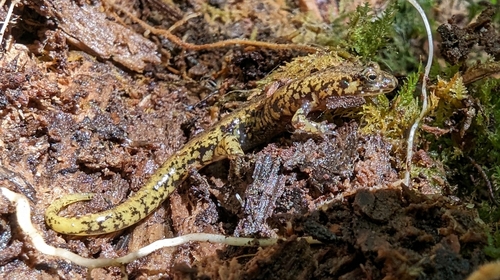
The spring salamander (Gyrinophilus porphyriticus) is a species of salamander in the family Plethodontidae (lungless salamanders). It is found in Canada and the United States. The genus, Gyrinophilus, means "tadpole lover" and refers to the long period of time it spends as a gilled larva before maturing. The specific epithet, porphyriticus, is Latin from Greek, meaning the color of porphyry, a purple stone, and this salamander has also been called the purple salamander. Its natural habitats are temperate forests, rivers, swamps, freshwater marshes, freshwater springs, inland karsts, and caves. In addition to insects, spiders, mites, millipedes, centipedes, slugs, snails, annelid worms, and other small invertebrates, the fairly large spring salamander may also consume smaller stream dwelling salamanders and their eggs, such as two-lined and dusky salamanders, as well as pygmy, ocoee, Jordan's, southern red-backed, southern Appalachian, and red salamanders. Wikipedia →
30–40% of wildlife watchers report a Spring Salamander sighting in Great Smoky Mountains National Park, based on 340 days of visitor records from GBIF citizen-science data.
Closest Relatives at Great Smoky Mountains National Park

Blue Ridge Two-lined Salamander
Eurycea wilderae

Red-cheeked Salamander
Plethodon jordani

Seal Salamander
Desmognathus monticola

Imitator Salamander
Desmognathus imitator

Southern Red-backed Salamander
Plethodon serratus

Red Salamander
Pseudotriton ruber

Pygmy Salamander
Desmognathus wrighti
Cherokee Mountain Dusky Salamander
Desmognathus adatsihi

Northern Slimy Salamander
Plethodon glutinosus

Southern Gray-cheeked Salamander
Plethodon metcalfi

Santeetlah Dusky Salamander
Desmognathus santeetlah

Long-tailed Salamander
Eurycea longicauda
📅 Monthly Probability
☀️🌙 When They're Spotted
Active throughout day and night · across all parks (global)
Global Distribution
Where this species is recorded worldwide. Restricted to human observations from 2019 onwards — the same kind of record and the same period the probabilities on this page are built from, so collar-tracking studies, camera-trap arrays and museum specimens are excluded. Around Santa Rosa that removes 5,924 GPS fixes from a handful of tagged jaguars.
where this species is recorded (GBIF density — it tracks where observers go, not how likely a sighting is) · parks where it occurs — tap a pin for the sighting probability there
Parks Where Found
| # | Park | Country | Probability |
|---|---|---|---|
| 1 | Great Smoky Mountains National Park | 🇺🇸 United States | |
| 2 | Shenandoah National Park | 🇺🇸 United States |
Quick answers
What are the chances of seeing a Spring Salamander in Great Smoky Mountains National Park?
About 38% of wildlife watchers report a Spring Salamander sighting in Great Smoky Mountains National Park, based on 340 days of visitor records from GBIF citizen-science data.
When is the best time to see Spring Salamander in Great Smoky Mountains National Park?
March has the highest sighting rate for Spring Salamander in Great Smoky Mountains National Park in our monthly data.