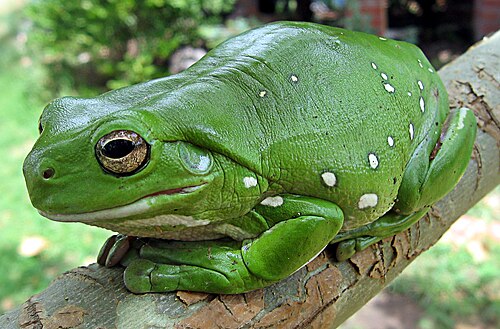


Ranoidea caerulea
Ranoidea caerulea
- KingdomAnimalia (Animals)
- PhylumChordata (Cordats)
- ClassAmphibia (Amfibis)
- OrderAnura (Anurs)
- FamilyPelodryadidae (Australasian Tree Frogs)
- GenusRanoidea
- SpeciesRanoidea caerulea (Ranoidea caerulea)
The Australian green tree frog (Pelodryas caerulea), also known as simply green tree frog in Australia, White's tree frog, or dumpy tree frog, is a species of tree frog native to Australia and New Guinea, with introduced populations in the United States and New Zealand, though the latter is believed to have died out. It is morphologically similar to some other members of its family, particularly the magnificent tree frog (P. splendida) and the white-lipped tree frog (Sandyrana infrafrenata). Larger than most Australian frogs, the Australian green tree frog reaches 10 cm (4 in) or more in length. Its average lifespan in captivity, about 16 years, is long compared with most frogs. Docile and well suited to living near human dwellings, Australian green tree frogs are often found on window sills or inside houses, eating insects drawn by the light. The green tree frog screams when it is in danger to scare off its foe, and squeaks when it is touched. Wikipedia →
30–40% of wildlife watchers report a Ranoidea caerulea sighting in Litchfield National Park, based on 14 days of visitor records from GBIF citizen-science data.
Closest Relatives at Litchfield National Park

giant frog
Ranoidea australis

Long-footed Frog
Ranoidea longipes

Rockhole Frog
Litoria meiriana

Desert Tree Frog
Litoria rubella

Watjulum Frog
Litoria watjulumensis

Australian Rocket Frog
Litoria nasuta

Copland's Rock Frog
Litoria coplandi
Pale Frog
Litoria pallida

Peter's Frog
Litoria inermis

Eastern Cane Toad
Rhinella marina

Ornate Burrowing Frog
Platyplectrum ornatum

Marbled Frog
Limnodynastes convexiusculus
📅 Monthly Probability
🕐 When They’re Spotted
Sightings of Ranoidea caerulea are recorded here, but fewer than 5 of them carry a time of day in GBIF — sighting probability uses whole days, so it is unaffected. The hourly pattern needs timestamps we don't have yet.
Global Distribution
Where this species is recorded worldwide. Restricted to human observations from 2019 onwards — the same kind of record and the same period the probabilities on this page are built from, so collar-tracking studies, camera-trap arrays and museum specimens are excluded. Around Santa Rosa that removes 5,924 GPS fixes from a handful of tagged jaguars.
where this species is recorded (GBIF density — it tracks where observers go, not how likely a sighting is) · parks where it occurs — tap a pin for the sighting probability there
Parks Where Found
| # | Park | Country | Probability |
|---|---|---|---|
| 1 | Litchfield National Park | 🇦🇺 Australia | |
| 2 | Kakadu National Park | 🇦🇺 Australia | |
| 3 | Nitmiluk National Park | 🇦🇺 Australia | |
| 4 | Lamington National Park | 🇦🇺 Australia | |
| 5 | Springbrook National Park | 🇦🇺 Australia | |
| 6 | Daintree National Park | 🇦🇺 Australia | |
| 7 | Noosa National Park | 🇦🇺 Australia | |
| 8 | Blue Mountains National Park | 🇦🇺 Australia |
Quick answers
What are the chances of seeing a Ranoidea caerulea in Litchfield National Park?
About 33% of wildlife watchers report a Ranoidea caerulea sighting in Litchfield National Park, based on 14 days of visitor records from GBIF citizen-science data.
When is the best time to see Ranoidea caerulea in Litchfield National Park?
December has the highest sighting rate for Ranoidea caerulea in Litchfield National Park in our monthly data.