


Mexican Burrowing Toad
Rhinophrynus dorsalis
- KingdomAnimalia (Animals)
- PhylumChordata (Cordats)
- ClassAmphibia (Amfibis)
- OrderAnura (Anurs)
- FamilyRhinophrynidae (Mexican burrowing toads)
- GenusRhinophrynus (Mexican Burrowing Toads)
- SpeciesRhinophrynus dorsalis (Mexican Burrowing Toad)
The Mexican burrowing toad (Rhinophrynus dorsalis) is the single living representative of the family Rhinophrynidae. It is a unique species in its taxonomy and morphology, with special adaptations to assist them in digging burrows where they spend most of their time. These adaptations include a small pointed snout and face, keratinized structures and a lack of webbing on front limbs, and specialized tongue morphology to assist in feeding on ants and termites underground. The body is nearly equal in width and length. It is a dark brown to black color with a red-orange stripe on its back along with splotches of color on its body. The generic name Rhinophrynus means 'nose-toad', from rhino- (ῥῑνο-), the combining form of the Ancient Greek rhis (ῥίς, 'nose') and phrunē (φρύνη, 'toad'). Wikipedia →
Closest Relatives at Montes Azules Biosphere Reserve

Mexican Smilisca
Smilisca baudinii

Central American Gulf Coast Toad
Incilius valliceps

Giant Marine Toad
Rhinella horribilis

Yellow Treefrog
Dendropsophus microcephalus

Stauffer's Tree Frog
Scinax staufferi

Browns' Frog
Lithobates brownorum

Vaillant's Frog
Lithobates vaillanti

Common Leaf-Litter Frog
Craugastor loki
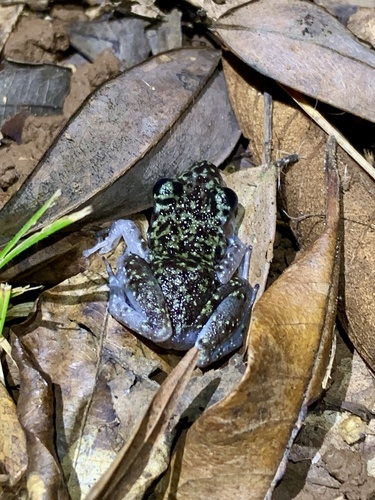
Leprus Chirping Frog
Eleutherodactylus leprus

Painted Tree Frog
Tlalocohyla picta

Alfred's Rainfrog
Craugastor alfredi

Harlequin Treefrog
Dendropsophus ebraccatus
📅 Monthly Probability
Fewer than 5 records of Mexican Burrowing Toad at Montes Azules Biosphere Reserve — not enough to chart months honestly.
☀️🌙 When They're Spotted
Active throughout day and night · across all parks (global)
Global Distribution
Where this species is recorded worldwide. Restricted to human observations from 2019 onwards — the same kind of record and the same period the probabilities on this page are built from, so collar-tracking studies, camera-trap arrays and museum specimens are excluded. Around Santa Rosa that removes 5,924 GPS fixes from a handful of tagged jaguars.
where this species is recorded (GBIF density — it tracks where observers go, not how likely a sighting is) · parks where it occurs — tap a pin for the sighting probability there
Parks Where Found
| # | Park | Country | Probability |
|---|---|---|---|
| 1 | Palo Verde National Park | 🇨🇷 Costa Rica | |
| 2 | Calakmul Biosphere Reserve | 🇲🇽 Mexico | |
| 3 | Santa Rosa National Park | 🇨🇷 Costa Rica | |
| 4 | Biotopo Cerro Cahuí | 🇬🇹 Guatemala | |
| 5 | Cockscomb Basin Wildlife Sanctuary | 🇧🇿 Belize | |
| 6 | Sian Ka'an Biosphere Reserve | 🇲🇽 Mexico | |
| 7 | Montes Azules Biosphere Reserve | 🇲🇽 Mexico | |
| 8 | Cumbres de Monterrey National Park | 🇲🇽 Mexico |