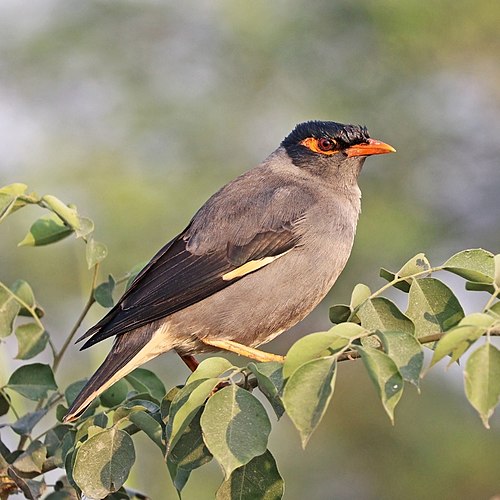


Bank Myna
Acridotheres ginginianus
- KingdomAnimalia (Animals)
- PhylumChordata (Cordats)
- ClassAves (Aus)
- OrderPasseriformes
- FamilySturnidae (Starlings)
- GenusAcridotheres (Typical Mynas)
- SpeciesAcridotheres ginginianus (Bank Myna)
The bank myna (Acridotheres ginginianus) is a myna found in the northern parts of South Asia. It is smaller but similar in colouration to the common myna, only differing in having brick-red naked skin behind the eyes instead of yellow. It is greyer on the underside and in this and in the presence of a slight tuft of feathers bears some resemblance to the jungle myna. They are found in flocks on the plains of northern and central India, often within towns and cities. Their range appears to be extending southwards into India. The name is derived from their habit of nesting almost exclusively in the earthen banks of rivers, where they excavate burrows and breed in large colonies. Wikipedia →
<5% of wildlife watchers report a Bank Myna sighting in Sundarbans National Park, based on 10 days of visitor records from GBIF citizen-science data.
Closest Relatives at Sundarbans National Park

Jungle Myna
Acridotheres fuscus

Indian Pied Starling
Gracupica contra

Chestnut-tailed Starling
Sturnia malabarica

Brahminy Starling
Sturnia pagodarum

Large-billed Crow
Corvus macrorhynchos

Oriental Magpie-Robin
Copsychus saularis

Bronzed Drongo
Dicrurus aeneus

Small Minivet
Pericrocotus cinnamomeus

Black Drongo
Dicrurus macrocercus

Common Tailorbird
Orthotomus sutorius

Barn Swallow
Hirundo rustica

Common Iora
Aegithina tiphia
📅 Monthly Probability
🌅 When They're Spotted
Most active at dawn and dusk · across all parks (global)
Global Distribution
Where this species is recorded worldwide. Restricted to human observations from 2019 onwards — the same kind of record and the same period the probabilities on this page are built from, so collar-tracking studies, camera-trap arrays and museum specimens are excluded. Around Santa Rosa that removes 5,924 GPS fixes from a handful of tagged jaguars.
where this species is recorded (GBIF density — it tracks where observers go, not how likely a sighting is) · parks where it occurs — tap a pin for the sighting probability there
Parks Where Found
| # | Park | Country | Probability |
|---|---|---|---|
| 1 | Keoladeo National Park | 🇮🇳 India | |
| 2 | Ranthambore National Park | 🇮🇳 India | |
| 3 | Kaziranga National Park | 🇮🇳 India | |
| 4 | Bandhavgarh National Park | 🇮🇳 India | |
| 5 | Royal Bardia National Park | 🇳🇵 Nepal | |
| 6 | Chitwan National Park | 🇳🇵 Nepal | |
| 7 | Jim Corbett National Park | 🇮🇳 India | |
| 8 | Sundarbans National Park | 🇮🇳 India | |
| 9 | Kanha National Park | 🇮🇳 India | |
| 10 | Satpura National Park | 🇮🇳 India |
Quick answers
What are the chances of seeing a Bank Myna in Sundarbans National Park?
About 1% of wildlife watchers report a Bank Myna sighting in Sundarbans National Park, based on 10 days of visitor records from GBIF citizen-science data.
When is the best time to see Bank Myna in Sundarbans National Park?
November has the highest sighting rate for Bank Myna in Sundarbans National Park in our monthly data.