
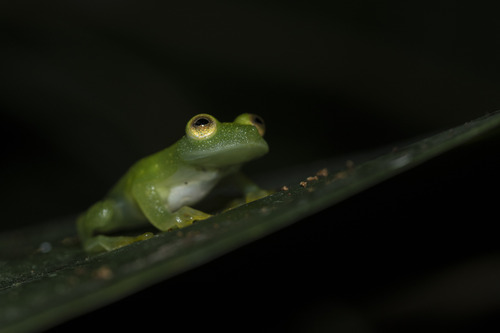
Emerald Glass Frog
Espadarana prosoblepon
- KingdomAnimalia (Animals)
- PhylumChordata (Cordats)
- ClassAmphibia (Amfibis)
- OrderAnura (Anurs)
- FamilyCentrolenidae (Glass Frogs)
- GenusEspadarana
- SpeciesEspadarana prosoblepon (Emerald Glass Frog)
Espadarana prosoblepon is a species of frog in the family Centrolenidae, commonly known as the emerald glass frog or Nicaragua giant glass frog. This species can be found in Ecuador, Colombia, Panama, Costa Rica, Nicaragua, and Honduras. Its natural habitats are lowland tropical forests and montane cloud forests. It is a nocturnal species occurring in low vegetation in mature forests only. It is not considered threatened overall by the IUCN although deforestation and pollution are potential threats, as is chytridiomycosis. The word "prosoblepon" originates from the Greek words "proso" and "blepo", which respectively mean "forward, in front" and "see, look", and is thought to signify the frontal position of the eyes in the emerald glass frog. Wikipedia →
20–30% of wildlife watchers report a Emerald Glass Frog sighting in Arenal Volcano National Park, based on 52 days of visitor records from GBIF citizen-science data.
Closest Relatives at Arenal Volcano National Park

Reticulated Glass Frog
Hyalinobatrachium valerioi

Chiriqui Glass Frog
Teratohyla pulverata

Ghost Glass Frog
Sachatamia ilex

Dwarf Glass Frog
Teratohyla spinosa

Grainy Cochran Frog
Cochranella granulosa
Tatayo's Glass Frog
Hyalinobatrachium tatayoi

Fleischmann's Glass Frog
Hyalinobatrachium fleischmanni

Red-eyed Treefrog
Agalychnis callidryas

Strawberry Poison-dart Frog
Oophaga pumilio

Warszewitsch's Frog
Lithobates warszewitschii

Masked Tree Frog
Smilisca phaeota

Giant Marine Toad
Rhinella horribilis
📅 Monthly Probability
🌙 When They're Spotted
Most active during nighttime hours (6pm–6am) · across all parks (global)
Global Distribution
Where this species is recorded worldwide. Restricted to human observations from 2019 onwards — the same kind of record and the same period the probabilities on this page are built from, so collar-tracking studies, camera-trap arrays and museum specimens are excluded. Around Santa Rosa that removes 5,924 GPS fixes from a handful of tagged jaguars.
where this species is recorded (GBIF density — it tracks where observers go, not how likely a sighting is) · parks where it occurs — tap a pin for the sighting probability there
Parks Where Found
| # | Park | Country | Probability |
|---|---|---|---|
| 1 | Chirripó National Park | 🇨🇷 Costa Rica | |
| 2 | Arenal Volcano National Park | 🇨🇷 Costa Rica | |
| 3 | Piedras Blancas National Park | 🇨🇷 Costa Rica | |
| 4 | Monteverde Cloud Forest Reserve | 🇨🇷 Costa Rica | |
| 5 | Braulio Carrillo National Park | 🇨🇷 Costa Rica | |
| 6 | La Amistad International Park (Panama) | 🇵🇦 Panama | |
| 7 | Tapantí-Macizo de la Muerte National Park | 🇨🇷 Costa Rica | |
| 8 | Corcovado National Park | 🇨🇷 Costa Rica | |
| 9 | Soberanía National Park | 🇵🇦 Panama | |
| 10 | Utría National Natural Park | 🇨🇴 Colombia | |
| 11 | Gandoca-Manzanillo Wildlife Refuge | 🇨🇷 Costa Rica | |
| 12 | Darién National Park | 🇵🇦 Panama | |
| 13 | Cahuita National Park | 🇨🇷 Costa Rica | |
| 14 | Manuel Antonio National Park | 🇨🇷 Costa Rica |
Quick answers
What are the chances of seeing a Emerald Glass Frog in Arenal Volcano National Park?
About 20% of wildlife watchers report a Emerald Glass Frog sighting in Arenal Volcano National Park, based on 52 days of visitor records from GBIF citizen-science data.
When is the best time to see Emerald Glass Frog in Arenal Volcano National Park?
November has the highest sighting rate for Emerald Glass Frog in Arenal Volcano National Park in our monthly data.