


Black Treesnake
Dendrelaphis punctulatus
- KingdomAnimalia (Animals)
- PhylumChordata (Cordats)
- ClassSquamata
- FamilyColubridae (Colúbrids)
- GenusDendrelaphis (Bronzebacks)
- SpeciesDendrelaphis punctulatus (Black Treesnake)
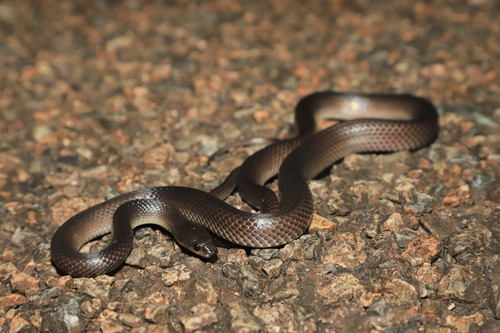
Dendrelaphis punctulatus, also known commonly as the Australian tree snake, the common tree snake, and the green tree snake, is a species of slender, large-eyed, diurnal, non-venomous snake in the family Colubridae. The species is native to many parts of Australia, especially in the northern and eastern coastal areas, and to Papua New Guinea. It is an agile snake with a very slender body and tail and is also a strong swimmer, using the water for hunting and avoiding predation. The ventral body colour varies from golden yellow, to bright green, to olive-green, to black, sometimes even blue, while its back is typically dark in colour. It is frequently pale yellow on the throat and belly, but other pale colours have been noted. Blue flecks are present on the flanks. Wikipedia →
10–20% of wildlife watchers report a Black Treesnake sighting in Litchfield National Park, based on 5 days of visitor records from GBIF citizen-science data.
Closest Relatives at Litchfield National Park


📅 Monthly Probability
☀️ When They're Spotted
Most active during daytime hours (6am–6pm) · across all parks (global)
Global Distribution
Where this species is recorded worldwide. Restricted to human observations from 2019 onwards — the same kind of record and the same period the probabilities on this page are built from, so collar-tracking studies, camera-trap arrays and museum specimens are excluded. Around Santa Rosa that removes 5,924 GPS fixes from a handful of tagged jaguars.
where this species is recorded (GBIF density — it tracks where observers go, not how likely a sighting is) · parks where it occurs — tap a pin for the sighting probability there
Parks Where Found
| # | Park | Country | Probability |
|---|---|---|---|
| 1 | Daintree National Park | 🇦🇺 Australia | |
| 2 | Nitmiluk National Park | 🇦🇺 Australia | |
| 3 | Kakadu National Park | 🇦🇺 Australia | |
| 4 | Noosa National Park | 🇦🇺 Australia | |
| 5 | Litchfield National Park | 🇦🇺 Australia | |
| 6 | Lamington National Park | 🇦🇺 Australia | |
| 7 | Springbrook National Park | 🇦🇺 Australia | |
| 8 | Royal National Park | 🇦🇺 Australia | |
| 9 | Blue Mountains National Park | 🇦🇺 Australia |
Quick answers
What are the chances of seeing a Black Treesnake in Litchfield National Park?
About 18% of wildlife watchers report a Black Treesnake sighting in Litchfield National Park, based on 5 days of visitor records from GBIF citizen-science data.
When is the best time to see Black Treesnake in Litchfield National Park?
November has the highest sighting rate for Black Treesnake in Litchfield National Park in our monthly data.