


Eastern Tiger Snake
Notechis scutatus
- KingdomAnimalia (Animals)
- PhylumChordata (Cordats)
- ClassSquamata
- FamilyElapidae (Elapid Snakes)
- GenusNotechis (Tiger Snakes)
- SpeciesNotechis scutatus (Eastern Tiger Snake)
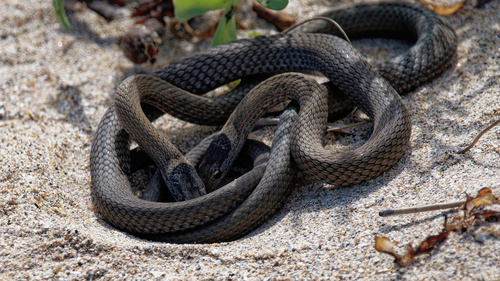
The tiger snake (Notechis scutatus) is a large and highly venomous snake of southern Australia, including its coastal islands and Tasmania. These snakes are often observed and locally well known by their banding, black and yellow like a tiger, although the species can be highly variable in colouration and patterning. All populations are classified within the genus Notechis (Elapidae). Their diverse characteristics have been classified either as distinct species or by subspecies and regional variation. While tiger snakes are usually ground-dwelling, they are able to swim as well as climb into trees and buildings. Wikipedia →
10–20% of wildlife watchers report a Eastern Tiger Snake sighting in Blue Mountains National Park, based on 71 days of visitor records from GBIF citizen-science data.
Closest Relatives at Blue Mountains National Park

Red-bellied Black Snake
Pseudechis porphyriacus

Highlands Copperhead
Austrelaps ramsayi
Mustard-bellied Snake
Drysdalia rhodogaster

Eastern Brown Snake
Pseudonaja textilis

Small-eyed Snake
Cryptophis nigrescens

Common Death Adder
Acanthophis antarcticus

Broad-headed Snake
Hoplocephalus bungaroides

Yellow-faced Whipsnake
Demansia psammophis

Golden Crowned Snake
Cacophis squamulosus

Bandy Bandy
Vermicella annulata

Red-naped Snake
Furina diadema

White-lipped Snake
Drysdalia coronoides
📅 Monthly Probability
☀️ When They're Spotted
Most active during daytime hours (6am–6pm) · across all parks (global)
Global Distribution
Where this species is recorded worldwide. Restricted to human observations from 2019 onwards — the same kind of record and the same period the probabilities on this page are built from, so collar-tracking studies, camera-trap arrays and museum specimens are excluded. Around Santa Rosa that removes 5,924 GPS fixes from a handful of tagged jaguars.
where this species is recorded (GBIF density — it tracks where observers go, not how likely a sighting is) · parks where it occurs — tap a pin for the sighting probability there
Parks Where Found
| # | Park | Country | Probability |
|---|---|---|---|
| 1 | Cradle Mountain-Lake St Clair National Park | 🇦🇺 Australia | |
| 2 | Wilsons Promontory National Park | 🇦🇺 Australia | |
| 3 | Maria Island National Park | 🇦🇺 Australia | |
| 4 | Great Otway National Park | 🇦🇺 Australia | |
| 5 | Freycinet National Park | 🇦🇺 Australia | |
| 6 | Lamington National Park | 🇦🇺 Australia | |
| 7 | Kosciuszko National Park | 🇦🇺 Australia | |
| 8 | Grampians National Park | 🇦🇺 Australia | |
| 9 | Blue Mountains National Park | 🇦🇺 Australia | |
| 10 | Royal National Park | 🇦🇺 Australia | |
| 11 | Springbrook National Park | 🇦🇺 Australia |
Quick answers
What are the chances of seeing a Eastern Tiger Snake in Blue Mountains National Park?
About 17% of wildlife watchers report a Eastern Tiger Snake sighting in Blue Mountains National Park, based on 71 days of visitor records from GBIF citizen-science data.
When is the best time to see Eastern Tiger Snake in Blue Mountains National Park?
February has the highest sighting rate for Eastern Tiger Snake in Blue Mountains National Park in our monthly data.