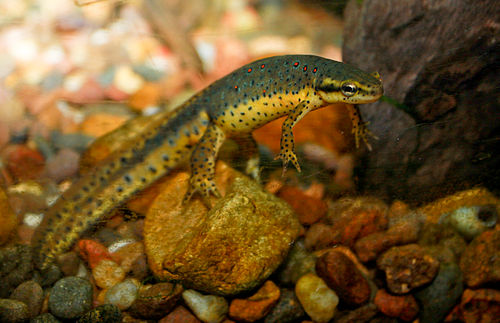


Eastern Newt
Notophthalmus viridescens
- KingdomAnimalia (Animals)
- PhylumChordata (Cordats)
- ClassAmphibia (Amfibis)
- OrderCaudata (Caudats)
- FamilySalamandridae (True Salamanders and Newts)
- GenusNotophthalmus (Eastern North American Newts)
- SpeciesNotophthalmus viridescens (Eastern Newt)
The eastern newt (Notophthalmus viridescens) is a common newt of eastern North America. It frequents small lakes, ponds, vernal ponds and streams or nearby wooded areas. The eastern newt produces tetrodotoxin, which makes the species unpalatable to predatory fish and crayfish. It has a lifespan of 12 to 15 years in the wild, and it may grow to 5 in (13 cm) in length. These animals are common aquarium pets, being either collected from the wild or sold commercially. The striking bright orange juvenile stage, which is land-dwelling, is known as a red eft. Wikipedia →
20–30% of wildlife watchers report a Eastern Newt sighting in Great Smoky Mountains National Park, based on 153 days of visitor records from GBIF citizen-science data.
Closest Relatives at Great Smoky Mountains National Park

Blue Ridge Two-lined Salamander
Eurycea wilderae

Red-cheeked Salamander
Plethodon jordani

Spring Salamander
Gyrinophilus porphyriticus

Seal Salamander
Desmognathus monticola

Imitator Salamander
Desmognathus imitator

Southern Red-backed Salamander
Plethodon serratus

Red Salamander
Pseudotriton ruber

Pygmy Salamander
Desmognathus wrighti
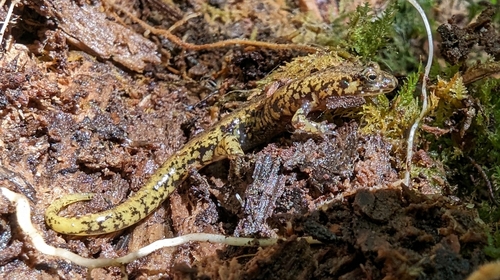
Cherokee Mountain Dusky Salamander
Desmognathus adatsihi

Northern Slimy Salamander
Plethodon glutinosus

Southern Gray-cheeked Salamander
Plethodon metcalfi

Santeetlah Dusky Salamander
Desmognathus santeetlah
📅 Monthly Probability
☀️ When They're Spotted
Most active during daytime hours (6am–6pm) · across all parks (global)
Global Distribution
Where this species is recorded worldwide. Restricted to human observations from 2019 onwards — the same kind of record and the same period the probabilities on this page are built from, so collar-tracking studies, camera-trap arrays and museum specimens are excluded. Around Santa Rosa that removes 5,924 GPS fixes from a handful of tagged jaguars.
where this species is recorded (GBIF density — it tracks where observers go, not how likely a sighting is) · parks where it occurs — tap a pin for the sighting probability there
Parks Where Found
| # | Park | Country | Probability |
|---|---|---|---|
| 1 | Shenandoah National Park | 🇺🇸 United States | |
| 2 | Great Smoky Mountains National Park | 🇺🇸 United States | |
| 3 | Acadia National Park | 🇺🇸 United States | |
| 4 | Cape Breton Highlands National Park | 🇨🇦 Canada | |
| 5 | Point Pelee National Park | 🇨🇦 Canada | |
| 6 | Big Cypress National Preserve | 🇺🇸 United States | |
| 7 | Isle Royale National Park | 🇺🇸 United States | |
| 8 | Everglades National Park | 🇺🇸 United States | |
| 9 | Voyageurs National Park | 🇺🇸 United States |
Quick answers
What are the chances of seeing a Eastern Newt in Great Smoky Mountains National Park?
About 24% of wildlife watchers report a Eastern Newt sighting in Great Smoky Mountains National Park, based on 153 days of visitor records from GBIF citizen-science data.
When is the best time to see Eastern Newt in Great Smoky Mountains National Park?
May has the highest sighting rate for Eastern Newt in Great Smoky Mountains National Park in our monthly data.