


Jungle Myna
Acridotheres fuscus
- KingdomAnimalia (Animals)
- PhylumChordata (Cordats)
- ClassAves (Aus)
- OrderPasseriformes
- FamilySturnidae (Starlings)
- GenusAcridotheres (Typical Mynas)
- SpeciesAcridotheres fuscus (Jungle Myna)
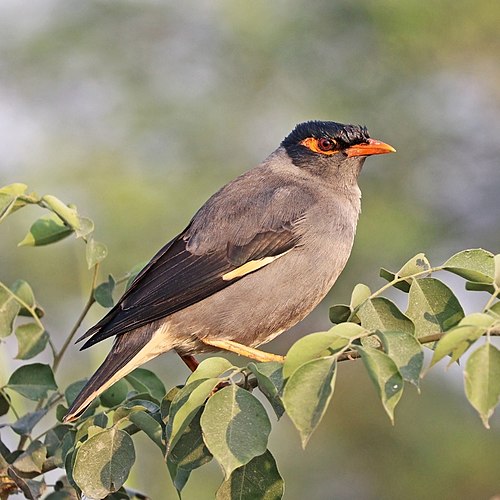
The jungle myna (Acridotheres fuscus) is a myna, a member of the starling family. It is found patchily distributed across much of the mainland of the Indian Subcontinent but absent in the arid zones of India. It is easily recognized by the tuft of feathers on its forehead that form a frontal crest, a feature also found in the closely related Javan myna and the pale-bellied myna which were treated as a subspecies in the past. The eyes are pale, yellow or blue depending on the population and the base of the orange-yellow bill is dark. It has also been introduced either intentionally or accidentally into many other parts of the world including Fiji, Taiwan, the Andaman Islands, and parts of Japan. The species has also spread out on its own to some islands in the Pacific. Wikipedia →
<5% of wildlife watchers report a Jungle Myna sighting in Kanha National Park, based on 100 days of visitor records from GBIF citizen-science data.
Closest Relatives at Kanha National Park
Bank Myna
Acridotheres ginginianus

Indian Pied Starling
Gracupica contra

Brahminy Starling
Sturnia pagodarum

Chestnut-tailed Starling
Sturnia malabarica

Common Hill Myna
Gracula religiosa

Rosy Starling
Pastor roseus

Rufous Treepie
Dendrocitta vagabunda

Black-hooded Oriole
Oriolus xanthornus

Black Drongo
Dicrurus macrocercus

Greater Racket-tailed Drongo
Dicrurus paradiseus

Oriental Magpie-Robin
Copsychus saularis

Jungle Babbler
Turdoides striata
📅 Monthly Probability
🌅 When They're Spotted
Most active at dawn and dusk · across all parks (global)
Global Distribution
Where this species is recorded worldwide. Restricted to human observations from 2019 onwards — the same kind of record and the same period the probabilities on this page are built from, so collar-tracking studies, camera-trap arrays and museum specimens are excluded. Around Santa Rosa that removes 5,924 GPS fixes from a handful of tagged jaguars.
where this species is recorded (GBIF density — it tracks where observers go, not how likely a sighting is) · parks where it occurs — tap a pin for the sighting probability there
Parks Where Found
| # | Park | Country | Probability |
|---|---|---|---|
| 1 | Kaziranga National Park | 🇮🇳 India | |
| 2 | Mudumalai National Park | 🇮🇳 India | |
| 3 | Nagarhole National Park | 🇮🇳 India | |
| 4 | Eravikulam National Park | 🇮🇳 India | |
| 5 | Chitwan National Park | 🇳🇵 Nepal | |
| 6 | Bandipur National Park | 🇮🇳 India | |
| 7 | Sundarbans National Park | 🇮🇳 India | |
| 8 | Periyar National Park | 🇮🇳 India | |
| 9 | Royal Bardia National Park | 🇳🇵 Nepal | |
| 10 | Jim Corbett National Park | 🇮🇳 India | |
| 11 | Namdapha National Park | 🇮🇳 India | |
| 12 | Royal Manas National Park | 🇧🇹 Bhutan | |
| 13 | Kanha National Park | 🇮🇳 India | |
| 14 | Bandhavgarh National Park | 🇮🇳 India | |
| 15 | Khao Sok National Park | 🇹🇭 Thailand |
Quick answers
What are the chances of seeing a Jungle Myna in Kanha National Park?
About 2% of wildlife watchers report a Jungle Myna sighting in Kanha National Park, based on 100 days of visitor records from GBIF citizen-science data.
When is the best time to see Jungle Myna in Kanha National Park?
June has the highest sighting rate for Jungle Myna in Kanha National Park in our monthly data.