


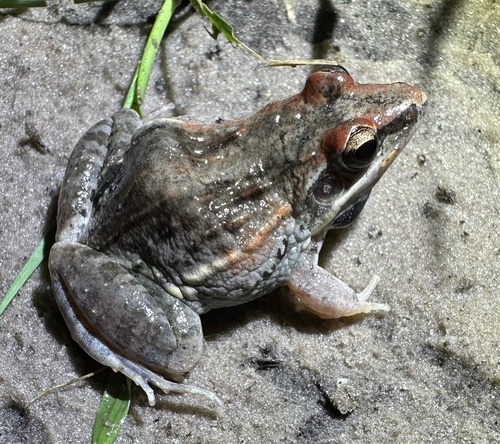
Red-Banded Rubber Frog
Phrynomantis bifasciatus
- KingdomAnimalia (Animals)
- PhylumChordata (Cordats)
- ClassAmphibia (Amfibis)
- OrderAnura (Anurs)
- FamilyMicrohylidae (Narrow-mouthed Frogs)
- GenusPhrynomantis
- SpeciesPhrynomantis bifasciatus (Red-Banded Rubber Frog)
The banded rubber frog (Phrynomantis bifasciatus) is a species of frog in the family Microhylidae. It is found in central and southern Africa. Its natural habitats are dry savanna, moist savanna, subtropical or tropical dry shrubland, subtropical or tropical moist shrubland, subtropical or tropical dry lowland grassland, subtropical or tropical seasonally wet or flooded lowland grassland, subtropical or tropical high-altitude grassland, intermittent freshwater lakes, intermittent freshwater marshes, arable land, pastureland, water storage areas, ponds, and canals and ditches. The female can reach a maximum size of 65 mm whereas the tadpoles can reach a size of 37 mm. The maximum size of the male is yet unknown, but sizes differ from 45 mm to 68 mm. Characteristics: Greyish underside with white spots (sometimes not apparent). Wikipedia →
Closest Relatives at Mana Pools National Park

Grey Foam-nest Treefrog
Chiromantis xerampelina

Anchieta's Ridged Frog
Ptychadena anchietae

Giant bullfrog
Pyxicephalus adspersus

Edible bullfrog
Pyxicephalus edulis

African Split-skin Toad
Schismaderma carens

Power's Rain Frog
Breviceps poweri

Shovel-nosed Frog
Hemisus marmoratus

Sharp-nosed ridged frog
Ptychadena oxyrhynchus

Marbled sand frog
Tomopterna marmorata
Mozambique ridged frog
Ptychadena mossambica

Guinea Snout-burrower
Hemisus guineensis

Margined Reed Frog
Hyperolius marginatus
📅 Monthly Probability
Fewer than 5 records of Red-Banded Rubber Frog at Mana Pools National Park — not enough to chart months honestly.
🌙 When They're Spotted
Most active during nighttime hours (6pm–6am) · across all parks (global)
Global Distribution
Where this species is recorded worldwide. Restricted to human observations from 2019 onwards — the same kind of record and the same period the probabilities on this page are built from, so collar-tracking studies, camera-trap arrays and museum specimens are excluded. Around Santa Rosa that removes 5,924 GPS fixes from a handful of tagged jaguars.
where this species is recorded (GBIF density — it tracks where observers go, not how likely a sighting is) · parks where it occurs — tap a pin for the sighting probability there
Parks Where Found
| # | Park | Country | Probability |
|---|---|---|---|
| 1 | Kruger National Park | 🇿🇦 South Africa | |
| 2 | iSimangaliso Wetland Park | 🇿🇦 South Africa | |
| 3 | Tsavo East National Park | 🇰🇪 Kenya | |
| 4 | Gonarezhou National Park | 🇿🇼 Zimbabwe | |
| 5 | Kafue National Park | 🇿🇲 Zambia | |
| 6 | Mikumi National Park | 🇹🇿 Tanzania | |
| 7 | Gorongosa National Park | 🇲🇿 Mozambique | |
| 8 | Liwonde National Park | 🇲🇼 Malawi | |
| 9 | Waterberg Plateau Park | 🇳🇦 Namibia | |
| 10 | Mana Pools National Park | 🇿🇼 Zimbabwe | |
| 11 | Mkomazi National Park | 🇹🇿 Tanzania | |
| 12 | Tarangire National Park | 🇹🇿 Tanzania | |
| 13 | Moremi Game Reserve | 🇧🇼 Botswana | |
| 14 | Hluhluwe-Imfolozi Park | 🇿🇦 South Africa | |
| 15 | Pilanesberg National Park | 🇿🇦 South Africa | |
| 16 | Hwange National Park | 🇿🇼 Zimbabwe | |
| 17 | Masai Mara National Reserve | 🇰🇪 Kenya | |
| 18 | Serengeti National Park | 🇹🇿 Tanzania |