


Drab Tree Frog
Smilisca sordida
- KingdomAnimalia (Animals)
- PhylumChordata (Cordats)
- ClassAmphibia (Amfibis)
- OrderAnura (Anurs)
- FamilyHylidae (Hylid Tree Frogs)
- GenusSmilisca (Cross-banded Tree Frogs)
- SpeciesSmilisca sordida (Drab Tree Frog)
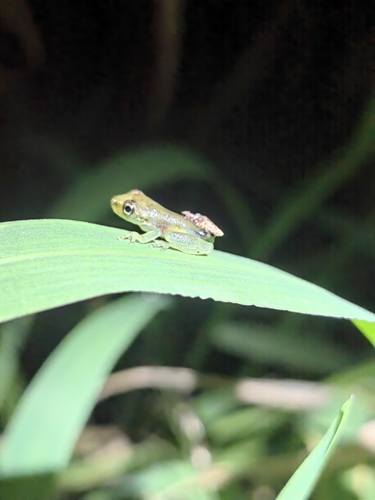
The Veragua cross-banded tree frog (Smilisca sordida) is a species of frog in the family Hylidae found in Colombia, Costa Rica, Honduras, Nicaragua, and Panama. Its natural habitats are subtropical or tropical moist lowland forests, subtropical or tropical moist montane forests, rivers, plantations, rural gardens, urban areas, heavily degraded former forests, and canals and ditches. Scientists have observed it as high in the hills as 1525 meters above sea level. The adult male frog measures 36.2 mm long in snout-vent length and the adult female frog 56.3 mm. The skin of the dorsum is gray-brown in color and the belly is lighter. It has purple skin near the groin. Wikipedia →
10–20% of wildlife watchers report a Drab Tree Frog sighting in Tenorio Volcano National Park, based on 6 days of visitor records from GBIF citizen-science data.
Closest Relatives at Tenorio Volcano National Park

Masked Tree Frog
Smilisca phaeota

Eastern Masked Tree Frog
Smilisca manisorum

Mexican Smilisca
Smilisca baudinii

Harlequin Treefrog
Dendropsophus ebraccatus

Sipurio Snouted Treefrog
Scinax elaeochroa

Red-webbed Tree Frog
Boana rufitela

Boulenger's Snouted Tree Frog
Scinax boulengeri
Tapir Valley Tree Frog
Tlalocohyla celeste

Yellow Treefrog
Dendropsophus microcephalus

San Carlos Treefrog
Dendropsophus phlebodes

Mahogany Tree Frog
Tlalocohyla loquax

Rufous-eyed brook frog
Duellmanohyla rufioculis
📅 Monthly Probability
🌙 When They're Spotted
Most active during nighttime hours (6pm–6am) · across all parks (global)
Global Distribution
Where this species is recorded worldwide. Restricted to human observations from 2019 onwards — the same kind of record and the same period the probabilities on this page are built from, so collar-tracking studies, camera-trap arrays and museum specimens are excluded. Around Santa Rosa that removes 5,924 GPS fixes from a handful of tagged jaguars.
where this species is recorded (GBIF density — it tracks where observers go, not how likely a sighting is) · parks where it occurs — tap a pin for the sighting probability there
Parks Where Found
| # | Park | Country | Probability |
|---|---|---|---|
| 1 | Piedras Blancas National Park | 🇨🇷 Costa Rica | |
| 2 | Braulio Carrillo National Park | 🇨🇷 Costa Rica | |
| 3 | Tenorio Volcano National Park | 🇨🇷 Costa Rica | |
| 4 | Arenal Volcano National Park | 🇨🇷 Costa Rica | |
| 5 | Carara National Park | 🇨🇷 Costa Rica | |
| 6 | Monteverde Cloud Forest Reserve | 🇨🇷 Costa Rica | |
| 7 | Corcovado National Park | 🇨🇷 Costa Rica | |
| 8 | Tortuguero National Park | 🇨🇷 Costa Rica | |
| 9 | La Amistad International Park (Panama) | 🇵🇦 Panama | |
| 10 | Chirripó National Park | 🇨🇷 Costa Rica | |
| 11 | Marino Ballena National Park | 🇨🇷 Costa Rica | |
| 12 | Palo Verde National Park | 🇨🇷 Costa Rica | |
| 13 | Gandoca-Manzanillo Wildlife Refuge | 🇨🇷 Costa Rica | |
| 14 | Soberanía National Park | 🇵🇦 Panama | |
| 15 | Tapantí-Macizo de la Muerte National Park | 🇨🇷 Costa Rica | |
| 16 | Cahuita National Park | 🇨🇷 Costa Rica |
Quick answers
What are the chances of seeing a Drab Tree Frog in Tenorio Volcano National Park?
About 14% of wildlife watchers report a Drab Tree Frog sighting in Tenorio Volcano National Park, based on 6 days of visitor records from GBIF citizen-science data.
When is the best time to see Drab Tree Frog in Tenorio Volcano National Park?
October has the highest sighting rate for Drab Tree Frog in Tenorio Volcano National Park in our monthly data.