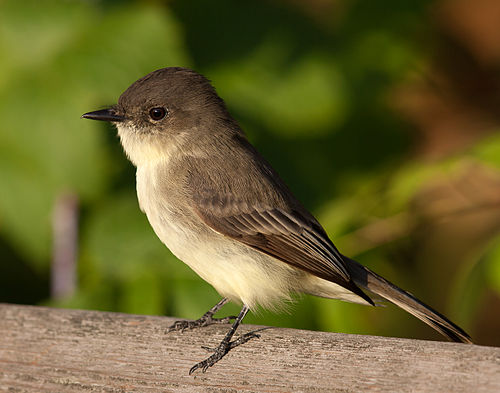


Eastern Phoebe
Sayornis phoebe
- KingdomAnimalia (Animals)
- PhylumChordata (Cordats)
- ClassAves (Aus)
- OrderPasseriformes
- FamilyTyrannidae (Tirànids)
- GenusSayornis (Phoebes)
- SpeciesSayornis phoebe (Eastern Phoebe)
The eastern phoebe (Sayornis phoebe) is a small passerine bird. The genus name Sayornis is constructed from the specific part of Charles Lucien Bonaparte's name for Say's phoebe, Muscicapa saya, and Ancient Greek ornis, "bird". Phoebe is an alternative name for the Roman moon goddess Diana, but it may also have been chosen to imitate the bird's call. Wikipedia →
Closest Relatives at Cape Breton Highlands National Park

Least Flycatcher
Empidonax minimus

Alder Flycatcher
Empidonax alnorum

Yellow-bellied Flycatcher
Empidonax flaviventris

Olive-sided Flycatcher
Contopus cooperi

Eastern Wood-Pewee
Contopus virens

Eastern Kingbird
Tyrannus tyrannus

Dark-eyed Junco
Junco hyemalis

American Robin
Turdus migratorius

American Crow
Corvus brachyrhynchos

Black-capped Chickadee
Poecile atricapillus

Yellow-rumped Warbler
Setophaga coronata

White-throated Sparrow
Zonotrichia albicollis
📅 Monthly Probability
Fewer than 5 records of Eastern Phoebe at Cape Breton Highlands National Park — not enough to chart months honestly.
☀️ When They're Spotted
Most active during daytime hours (6am–6pm) · across all parks (global)
Global Distribution
Where this species is recorded worldwide. Restricted to human observations from 2019 onwards — the same kind of record and the same period the probabilities on this page are built from, so collar-tracking studies, camera-trap arrays and museum specimens are excluded. Around Santa Rosa that removes 5,924 GPS fixes from a handful of tagged jaguars.
where this species is recorded (GBIF density — it tracks where observers go, not how likely a sighting is) · parks where it occurs — tap a pin for the sighting probability there