


Masked Tree Frog
Smilisca phaeota
- KingdomAnimalia (Animals)
- PhylumChordata (Cordats)
- ClassAmphibia (Amfibis)
- OrderAnura (Anurs)
- FamilyHylidae (Hylid Tree Frogs)
- GenusSmilisca (Cross-banded Tree Frogs)
- SpeciesSmilisca phaeota (Masked Tree Frog)
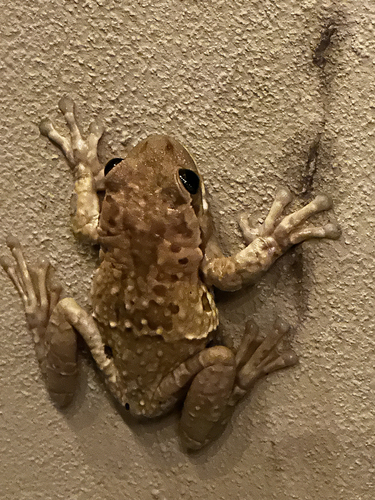
The New Granada cross-banded tree frog (Smilisca phaeota), also known as the masked tree frog, is a species of frog in the family Hylidae found in Colombia, Costa Rica, Ecuador, Honduras, Nicaragua, and Panama. Its natural habitats are subtropical or tropical dry forest, subtropical or tropical moist lowland forest, rivers, freshwater marshes, intermittent freshwater marshes, plantations, rural gardens, urban areas, heavily degraded former forests, ponds, and canals and ditches. Their nickname of masked tree frog comes from the black or dark colored markings that start at their nose and go back along the face toward their ear, covering their eye. Because it goes across their eye, it can help with camouflage, as many predators find prey by their open eyes. Wikipedia →
10–20% of wildlife watchers report a Masked Tree Frog sighting in Carara National Park, based on 12 days of visitor records from GBIF citizen-science data.
Closest Relatives at Carara National Park

Drab Tree Frog
Smilisca sordida

Mexican Smilisca
Smilisca baudinii

Harlequin Treefrog
Dendropsophus ebraccatus

Yellow Treefrog
Dendropsophus microcephalus

Sipurio Snouted Treefrog
Scinax elaeochroa
Milk Frog
Trachycephalus macrotis

Rosenberg's Gladiator Frog
Boana rosenbergi

Boulenger's Snouted Tree Frog
Scinax boulengeri

Stauffer's Tree Frog
Scinax staufferi

Green and Black Dart-poison Frog
Dendrobates auratus

Giant Marine Toad
Rhinella horribilis

Red-eyed Treefrog
Agalychnis callidryas
📅 Monthly Probability
🌙 When They're Spotted
Most active during nighttime hours (6pm–6am) · across all parks (global)
Global Distribution
Where this species is recorded worldwide. Restricted to human observations from 2019 onwards — the same kind of record and the same period the probabilities on this page are built from, so collar-tracking studies, camera-trap arrays and museum specimens are excluded. Around Santa Rosa that removes 5,924 GPS fixes from a handful of tagged jaguars.
where this species is recorded (GBIF density — it tracks where observers go, not how likely a sighting is) · parks where it occurs — tap a pin for the sighting probability there
Parks Where Found
Quick answers
What are the chances of seeing a Masked Tree Frog in Carara National Park?
About 12% of wildlife watchers report a Masked Tree Frog sighting in Carara National Park, based on 12 days of visitor records from GBIF citizen-science data.
When is the best time to see Masked Tree Frog in Carara National Park?
August has the highest sighting rate for Masked Tree Frog in Carara National Park in our monthly data.