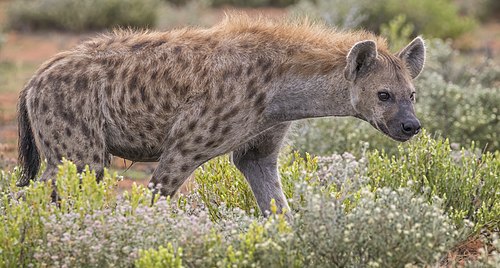


Spotted Hyena
Crocuta crocuta
- KingdomAnimalia (Animals)
- PhylumChordata (Cordats)
- ClassMammalia (Mamífers)
- OrderCarnivora (Carnívors)
- FamilyHyaenidae (Hyaenas)
- GenusCrocuta (Common Hyenas)
- SpeciesCrocuta crocuta (Spotted Hyena)
The spotted hyena (Crocuta crocuta), also known as the laughing hyena, is a hyena species, currently classed as the sole extant member of the genus Crocuta, native to sub-Saharan Africa. It is listed as being of least concern by the IUCN due to its widespread range and large numbers estimated between 27,000 and 47,000 individuals. The species is, however, experiencing declines outside of protected areas due to habitat loss and poaching. Populations of Crocuta, usually considered a subspecies of Crocuta crocuta, known as cave hyenas, roamed across Eurasia for at least one million years until the end of the Late Pleistocene. The spotted hyena is the largest extant member of the Hyaenidae, and is further physically distinguished from other species by its vaguely bear-like build, rounded ears, less prominent mane, spotted pelt, more dual-purposed dentition, fewer nipples, and pseudo-penis. It is the only placental mammalian species where females have a pseudo-penis and lack an external vaginal opening. Wikipedia →
Closest Relatives at Namib-Naukluft National Park

Brown Hyaena
Hyaena brunnea

Aardwolf
Proteles cristata

Afro-Australian Fur Seal
Arctocephalus pusillus

Yellow Mongoose
Cynictis penicillata

Cape Fox
Vulpes chama

Bat-eared Fox
Otocyon megalotis

Slender-tailed Meerkat
Suricata suricatta

Leopard
Panthera pardus

African Wildcat
Felis lybica

Cheetah
Acinonyx jubatus

Slender Mongoose
Galerella sanguinea

Northern Small-spotted Genet
Genetta genetta
📅 Monthly Probability
Fewer than 5 records of Spotted Hyena at Namib-Naukluft National Park — not enough to chart months honestly.
☀️ When They're Spotted
Most active during daytime hours (6am–6pm) · across all parks (global)
Global Distribution
Where this species is recorded worldwide. Restricted to human observations from 2019 onwards — the same kind of record and the same period the probabilities on this page are built from, so collar-tracking studies, camera-trap arrays and museum specimens are excluded. Around Santa Rosa that removes 5,924 GPS fixes from a handful of tagged jaguars.
where this species is recorded (GBIF density — it tracks where observers go, not how likely a sighting is) · parks where it occurs — tap a pin for the sighting probability there