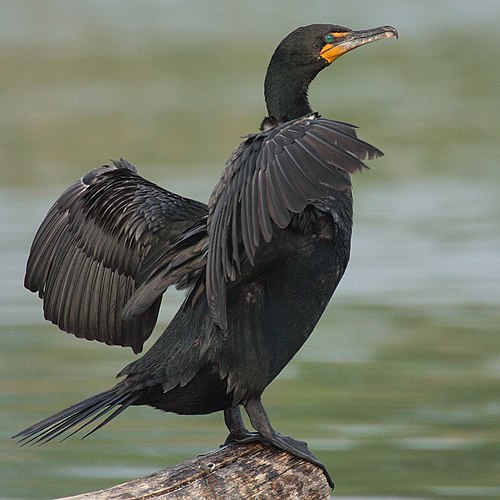
Double-crested Cormorant
Phalacrocorax auritus
- KingdomAnimalia (Animals)
- PhylumChordata (Cordats)
- ClassAves (Aus)
- OrderSuliformes
- FamilyPhalacrocoracidae (Corbs marins)
- GenusPhalacrocorax (Typical Old World Cormorants)
- SpeciesPhalacrocorax auritus (Double-crested Cormorant)
The double-crested cormorant (Nannopterum auritum) is a member of the cormorant family of water birds. It is found near rivers and lakes and in coastal areas and is widely distributed across North America, from the Aleutian Islands in Alaska down to Florida and Mexico. Measuring 70–90 cm (28–35 in) in length, it is entirely black except for a bare patch of orange-yellow facial skin and some extra plumage that it exhibits in the breeding season when it grows a double crest in which black feathers are mingled with white. Five subspecies are recognized. It mainly eats fish and hunts by swimming and diving. Its feathers, like all cormorants, are not waterproof, and it must dry them out after spending time in the water. Wikipedia →
50–60% of wildlife watchers report a Double-crested Cormorant sighting in El Vizcaíno Biosphere Reserve, based on 494 days of visitor records from GBIF citizen-science data.
Closest Relatives at El Vizcaíno Biosphere Reserve


📅 Monthly Probability
☀️ When They're Spotted
Most active during daytime hours (6am–6pm) · across all parks (global)
Global Distribution
Where this species is recorded worldwide. Restricted to human observations from 2019 onwards — the same kind of record and the same period the probabilities on this page are built from, so collar-tracking studies, camera-trap arrays and museum specimens are excluded. Around Santa Rosa that removes 5,924 GPS fixes from a handful of tagged jaguars.
where this species is recorded (GBIF density — it tracks where observers go, not how likely a sighting is) · parks where it occurs — tap a pin for the sighting probability there
Parks Where Found
Quick answers
What are the chances of seeing a Double-crested Cormorant in El Vizcaíno Biosphere Reserve?
About 59% of wildlife watchers report a Double-crested Cormorant sighting in El Vizcaíno Biosphere Reserve, based on 494 days of visitor records from GBIF citizen-science data.
When is the best time to see Double-crested Cormorant in El Vizcaíno Biosphere Reserve?
April has the highest sighting rate for Double-crested Cormorant in El Vizcaíno Biosphere Reserve in our monthly data.