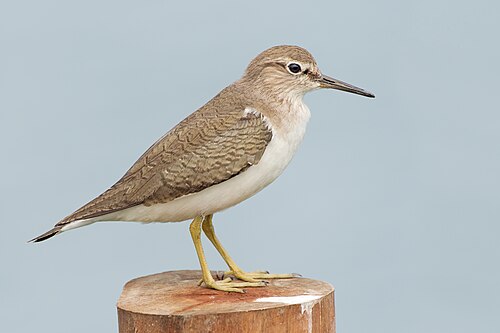
Ruff

Ruff

Calidris pugnax

Least ConcernNear ThreatenedVulnerableEndangeredCritically Endangered
<5% · Rare
overall probability at Tsavo East National Park
44 Verified records at Tsavo East National Park
February Best month highest sighting rate
☀️ Diurnal When it's active during daytime hours (6am–6pm)

The ruff (Calidris pugnax) is a medium-sized wading bird that breeds in marshes and wet meadows across northern Eurasia. This highly gregarious sandpiper is migratory and sometimes forms huge flocks in its winter grounds, which include southern and western Europe, Africa, southern Asia and Australia. The ruff is a long-necked, pot-bellied bird. This species shows marked sexual dimorphism; the male is much larger than the female (the reeve), and has a breeding plumage that includes brightly coloured head tufts, bare orange facial skin, extensive black on the breast, and the large collar of ornamental feathers that inspired this bird's English name. The female and the non-breeding male have grey-brown upperparts and mainly white underparts. Three differently plumaged types of male, including a rare form that mimics the female, use a variety of strategies to obtain mating opportunities at a lek, and the colourful head and neck feathers are erected as part of the elaborate main courting display. Wikipedia →

<5% of wildlife watchers report a Ruff sighting in Tsavo East National Park, based on 44 days of visitor records from GBIF citizen-science data.

📅 Monthly Probability

5–10
Jan
5–10
Feb
<5
Mar
<5
Apr
<5
May
<5
Jun
<5
Jul
<5
Aug
<5
Sep
<5
Oct
<5
Nov
<5
Dec

☀️ When They're Spotted

Most active during daytime hours (6am–6pm) · across all parks (global)

☀️Diurnal
☀️🌙🌙12am6am12pm6pm12am

Global Distribution

Where this species is recorded worldwide. Restricted to human observations from 2019 onwards — the same kind of record and the same period the probabilities on this page are built from, so collar-tracking studies, camera-trap arrays and museum specimens are excluded. Around Santa Rosa that removes 5,924 GPS fixes from a handful of tagged jaguars.

where this species is recorded (GBIF density — it tracks where observers go, not how likely a sighting is)  ·  parks where it occurs — tap a pin for the sighting probability there

Parks Where Found

# Park Country Probability
1 Fertő-Hanság National Park 🇭🇺 Hungary
50–60%
2 Hortobágy National Park 🇭🇺 Hungary
30–40%
3 Arusha National Park 🇹🇿 Tanzania
30–40%
4 Biebrza National Park 🇵🇱 Poland
30–40%
5 Amboseli National Park 🇰🇪 Kenya
30–40%
6 Kiskunság National Park 🇭🇺 Hungary
30–40%
7 Lake Nakuru National Park 🇰🇪 Kenya
20–30%
8 Ngorongoro Conservation Area 🇹🇿 Tanzania
20–30%
9 Chobe National Park 🇧🇼 Botswana
10–20%
10 Moremi Game Reserve 🇧🇼 Botswana
10–20%
11 Keoladeo National Park 🇮🇳 India
10–20%
12 Etosha National Park 🇳🇦 Namibia
10–20%
13 Białowieża National Park 🇵🇱 Poland
10–20%
14 Mana Pools National Park 🇿🇼 Zimbabwe
10–20%
15 Wadden Sea National Park 🇩🇪 Germany
10–20%
16 Serengeti National Park 🇹🇿 Tanzania
10–20%
17 Namib-Naukluft National Park 🇳🇦 Namibia
10–20%
18 Doñana National Park 🇪🇸 Spain
10–20%
19 Nairobi National Park 🇰🇪 Kenya
5–10%
20 Hwange National Park 🇿🇼 Zimbabwe
5–10%
21 Lower Zambezi National Park 🇿🇲 Zambia
5–10%
22 Tarangire National Park 🇹🇿 Tanzania
5–10%
23 Ranthambore National Park 🇮🇳 India
5–10%
24 Awash National Park 🇪🇹 Ethiopia
5–10%
25 South Luangwa National Park 🇿🇲 Zambia
<5%
26 Bavarian Forest National Park 🇩🇪 Germany
<5%
27 iSimangaliso Wetland Park 🇿🇦 South Africa
<5%
28 Lake Manyara National Park 🇹🇿 Tanzania
<5%
29 Gorongosa National Park 🇲🇿 Mozambique
<5%
30 Liwonde National Park 🇲🇼 Malawi
<5%
31 Kafue National Park 🇿🇲 Zambia
<5%
32 Tsavo East National Park 🇰🇪 Kenya
<5%
33 Queen Elizabeth National Park 🇺🇬 Uganda
<5%
34 Semuliki National Park 🇺🇬 Uganda
<5%
35 Kruger National Park 🇿🇦 South Africa
<5%
36 Hemis National Park 🇮🇳 India
<5%
37 Kaziranga National Park 🇮🇳 India
<5%
38 Garden Route National Park 🇿🇦 South Africa
<5%
39 Yala National Park 🇱🇰 Sri Lanka
<5%
40 Masai Mara National Reserve 🇰🇪 Kenya
<5%
41 Addo Elephant National Park 🇿🇦 South Africa
<5%
42 Murchison Falls National Park 🇺🇬 Uganda
<5%
43 Samburu National Reserve 🇰🇪 Kenya
<5%
44 Virunga National Park 🇨🇩 Democratic Republic of the Congo
<5%
45 Monfragüe National Park 🇪🇸 Spain
<5%
46 Tsavo West National Park 🇰🇪 Kenya
<5%
47 Snowdonia National Park 🇬🇧 United Kingdom
<5%
48 Pyrénées National Park 🇫🇷 France
<5%
49 Sierra de Guadarrama National Park 🇪🇸 Spain
<5%
50 Olympic National Park 🇺🇸 United States
<5%
51 Selous Game Reserve 🇹🇿 Tanzania
Insufficient data
52 Kgalagadi Transfrontier Park 🇿🇦 South Africa
Insufficient data
53 Channel Islands National Park 🇺🇸 United States
Insufficient data
54 Mikumi National Park 🇹🇿 Tanzania
Insufficient data
55 Gonarezhou National Park 🇿🇼 Zimbabwe
Insufficient data
56 Ruaha National Park 🇹🇿 Tanzania
Insufficient data
57 Pilanesberg National Park 🇿🇦 South Africa
Insufficient data
58 Chitwan National Park 🇳🇵 Nepal
Insufficient data
59 Aberdare National Park 🇰🇪 Kenya
Insufficient data
60 Akagera National Park 🇷🇼 Rwanda
Insufficient data
61 Tatra National Park 🇸🇰 Slovakia
Insufficient data
62 Kibale National Park 🇺🇬 Uganda
Insufficient data
63 Sundarbans National Park 🇮🇳 India
Insufficient data
64 Vatnajokull National Park 🇮🇸 Iceland
Insufficient data
65 Lake Mburo National Park 🇺🇬 Uganda
Insufficient data
66 Pacific Rim National Park Reserve 🇨🇦 Canada
Insufficient data
67 Table Mountain National Park 🇿🇦 South Africa
Insufficient data
68 Great Bear Rainforest 🇨🇦 Canada
Insufficient data

Quick answers

What are the chances of seeing a Ruff in Tsavo East National Park?

About 2% of wildlife watchers report a Ruff sighting in Tsavo East National Park, based on 44 days of visitor records from GBIF citizen-science data.

When is the best time to see Ruff in Tsavo East National Park?

February has the highest sighting rate for Ruff in Tsavo East National Park in our monthly data.

← Back to Tsavo East National Park