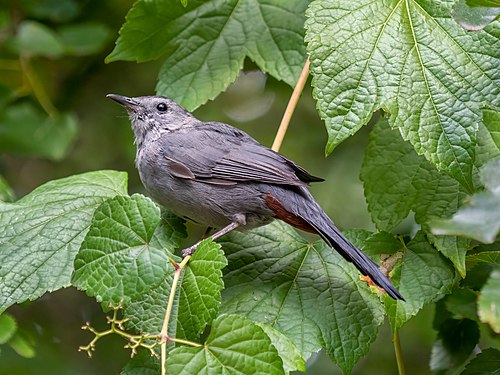
Gray Catbird

Gray Catbird

Dumetella carolinensis

Least ConcernNear ThreatenedVulnerableEndangeredCritically Endangered
20–30% · Possible
overall probability at Biotopo Cerro Cahuí
34 Verified records at Biotopo Cerro Cahuí
October Best month highest sighting rate
☀️ Diurnal When it's active during daytime hours (6am–6pm)

The gray catbird (Dumetella carolinensis), also spelled grey catbird, is a medium-sized North American and Central American perching bird of the mimid family. It is the only member of the "catbird" genus Dumetella. Like the black catbird (Melanoptila glabrirostris), it is among the basal lineages of the Mimidae, probably a closer relative of the Caribbean thrasher and trembler assemblage than of the mockingbirds and Toxostoma thrashers. In some areas it is known as the slate-colored mockingbird. Wikipedia →

20–30% of wildlife watchers report a Gray Catbird sighting in Biotopo Cerro Cahuí, based on 34 days of visitor records from GBIF citizen-science data.

📅 Monthly Probability

30–40
Jan
10–20
Feb
20–30
Mar
30–40
Apr
10–20
May
10–20
Jun
10–20
Jul
10–20
Aug
10–20
Sep
30–40
Oct
10–20
Nov
20–30
Dec

☀️ When They're Spotted

Most active during daytime hours (6am–6pm) · across all parks (global)

☀️Diurnal
☀️🌙🌙12am6am12pm6pm12am

Global Distribution

Where this species is recorded worldwide. Restricted to human observations from 2019 onwards — the same kind of record and the same period the probabilities on this page are built from, so collar-tracking studies, camera-trap arrays and museum specimens are excluded. Around Santa Rosa that removes 5,924 GPS fixes from a handful of tagged jaguars.

where this species is recorded (GBIF density — it tracks where observers go, not how likely a sighting is)  ·  parks where it occurs — tap a pin for the sighting probability there

Parks Where Found

# Park Country Probability
1 Point Pelee National Park 🇨🇦 Canada
60–70%
2 Cockscomb Basin Wildlife Sanctuary 🇧🇿 Belize
50–60%
3 Ciénaga de Zapata 🇨🇺 Cuba
50–60%
4 Everglades National Park 🇺🇸 United States
40–50%
5 Big Cypress National Preserve 🇺🇸 United States
40–50%
6 Montes Azules Biosphere Reserve 🇲🇽 Mexico
40–50%
7 Arrecifes de Cozumel National Park 🇲🇽 Mexico
30–40%
8 Calakmul Biosphere Reserve 🇲🇽 Mexico
30–40%
9 Sian Ka'an Biosphere Reserve 🇲🇽 Mexico
30–40%
10 Pico Bonito National Park 🇭🇳 Honduras
30–40%
11 Lago de Yojoa 🇭🇳 Honduras
20–30%
12 Shenandoah National Park 🇺🇸 United States
20–30%
13 Acadia National Park 🇺🇸 United States
20–30%
14 Biotopo Cerro Cahuí 🇬🇹 Guatemala
20–30%
15 Great Smoky Mountains National Park 🇺🇸 United States
10–20%
16 Riding Mountain National Park 🇨🇦 Canada
10–20%
17 Cañón del Sumidero National Park 🇲🇽 Mexico
10–20%
18 Cusuco National Park 🇭🇳 Honduras
10–20%
19 Celestún Biosphere Reserve 🇲🇽 Mexico
10–20%
20 Cerro Azul Meámbar National Park 🇭🇳 Honduras
10–20%
21 Bastimentos Island National Marine Park 🇵🇦 Panama
10–20%
22 Elk Island National Park 🇨🇦 Canada
10–20%
23 Grand Teton National Park 🇺🇸 United States
10–20%
24 Glacier National Park 🇺🇸 United States
10–20%
25 Congaree National Park 🇺🇸 United States
10–20%
26 Cumbres de Monterrey National Park 🇲🇽 Mexico
5–10%
27 Celaque National Park 🇭🇳 Honduras
5–10%
28 Ría Lagartos Biosphere Reserve 🇲🇽 Mexico
5–10%
29 La Amistad International Park (Panama) 🇵🇦 Panama
5–10%
30 Jasper National Park 🇨🇦 Canada
<5%
31 Rocky Mountain National Park 🇺🇸 United States
<5%
32 La Tigra National Park 🇭🇳 Honduras
<5%
33 Badlands National Park 🇺🇸 United States
<5%
34 Big Bend National Park 🇺🇸 United States
<5%
35 Banff National Park 🇨🇦 Canada
<5%
36 Tortuguero National Park 🇨🇷 Costa Rica
<5%
37 Yellowstone National Park 🇺🇸 United States
<5%
38 Voyageurs National Park 🇺🇸 United States
<5%
39 Cahuita National Park 🇨🇷 Costa Rica
<5%
40 Cape Breton Highlands National Park 🇨🇦 Canada
<5%
41 Isle Royale National Park 🇺🇸 United States
<5%
42 Gandoca-Manzanillo Wildlife Refuge 🇨🇷 Costa Rica
<5%
43 El Vizcaíno Biosphere Reserve 🇲🇽 Mexico
<5%
44 Death Valley National Park 🇺🇸 United States
<5%
45 Parque Natural Metropolitano 🇵🇦 Panama
<5%
46 Sequoia and Kings Canyon National Parks 🇺🇸 United States
<5%
47 Soberanía National Park 🇵🇦 Panama
<5%
48 Braulio Carrillo National Park 🇨🇷 Costa Rica
<5%
49 Tenorio Volcano National Park 🇨🇷 Costa Rica
<5%
50 Olympic National Park 🇺🇸 United States
<5%
51 Arenal Volcano National Park 🇨🇷 Costa Rica
<5%
52 Monteverde Cloud Forest Reserve 🇨🇷 Costa Rica
<5%
53 Pacific Rim National Park Reserve 🇨🇦 Canada
Insufficient data
54 El Triunfo 🇲🇽 Mexico
Insufficient data
55 Guadalupe Mountains National Park 🇺🇸 United States
Insufficient data
56 Santa Rosa National Park 🇨🇷 Costa Rica
Insufficient data
57 Blue and John Crow Mountains National Park 🇯🇲 Jamaica
Insufficient data
58 Chagres National Park 🇵🇦 Panama
Insufficient data
59 Los Haitises National Park 🇩🇴 Dominican Republic
Insufficient data
60 Grand Canyon National Park 🇺🇸 United States
Insufficient data
61 Las Baulas Marine National Park 🇨🇷 Costa Rica
Insufficient data
62 Darién National Park 🇵🇦 Panama
Insufficient data
63 Gros Morne National Park 🇨🇦 Canada
Insufficient data
64 Yosemite National Park 🇺🇸 United States
Insufficient data
65 Chirripó National Park 🇨🇷 Costa Rica
Insufficient data
66 Carara National Park 🇨🇷 Costa Rica
Insufficient data
67 Great Bear Rainforest 🇨🇦 Canada
Insufficient data
68 Channel Islands National Park 🇺🇸 United States
Insufficient data
69 Joshua Tree National Park 🇺🇸 United States
Insufficient data

Quick answers

What are the chances of seeing a Gray Catbird in Biotopo Cerro Cahuí?

About 23% of wildlife watchers report a Gray Catbird sighting in Biotopo Cerro Cahuí, based on 34 days of visitor records from GBIF citizen-science data.

When is the best time to see Gray Catbird in Biotopo Cerro Cahuí?

October has the highest sighting rate for Gray Catbird in Biotopo Cerro Cahuí in our monthly data.

← Back to Biotopo Cerro Cahuí