


Red-winged Blackbird
Agelaius phoeniceus
- KingdomAnimalia (Animals)
- PhylumChordata (Cordats)
- ClassAves (Aus)
- OrderPasseriformes
- FamilyIcteridae (Ictèrids)
- GenusAgelaius (Agelaius Blackbirds)
- SpeciesAgelaius phoeniceus (Red-winged Blackbird)
The red-winged blackbird (Agelaius phoeniceus) is a passerine bird of the family Icteridae found in most of North America and much of Central America. It breeds from Alaska and Newfoundland south to Florida, the Gulf of Mexico, Mexico, and Guatemala, with isolated populations in western El Salvador, northwestern Honduras, and northwestern Costa Rica. It may winter as far north as Pennsylvania and British Columbia, but northern populations are generally migratory, moving south to Mexico and the Southern United States. Claims have been made that it is the most abundant living land bird in North America, as bird-counting censuses of wintering red-winged blackbirds sometimes show that loose flocks can number in excess of a million birds per flock and the full number of breeding pairs across North and Central America may exceed 250 million in peak years. It also ranks among the best-studied wild bird species in the world. The red-winged blackbird is sexually dimorphic; the male is all black with a red shoulder and yellow wing bar, while the female is a nondescript dark brown. Wikipedia →
Closest Relatives at Gros Morne National Park
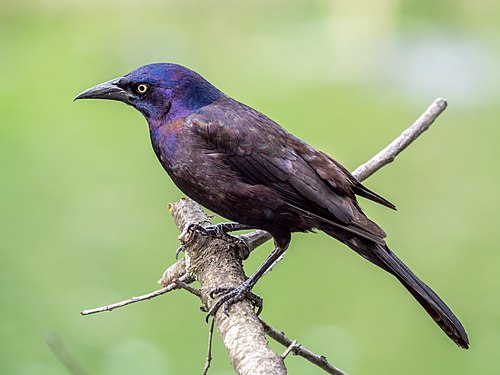
Common Grackle
Quiscalus quiscula

Brewer's Blackbird
Euphagus cyanocephalus

Rusty Blackbird
Euphagus carolinus

Brown-headed Cowbird
Molothrus ater

American Robin
Turdus migratorius

White-throated Sparrow
Zonotrichia albicollis

Black-and-white Warbler
Mniotilta varia

Yellow Warbler
Setophaga petechia

Ruby-crowned Kinglet
Regulus calendula

Swainson's Thrush
Catharus ustulatus

American Crow
Corvus brachyrhynchos

Yellow-rumped Warbler
Setophaga coronata
📅 Monthly Probability
Fewer than 5 records of Red-winged Blackbird at Gros Morne National Park — not enough to chart months honestly.
☀️ When They're Spotted
Most active during daytime hours (6am–6pm) · across all parks (global)
Global Distribution
Where this species is recorded worldwide. Restricted to human observations from 2019 onwards — the same kind of record and the same period the probabilities on this page are built from, so collar-tracking studies, camera-trap arrays and museum specimens are excluded. Around Santa Rosa that removes 5,924 GPS fixes from a handful of tagged jaguars.
where this species is recorded (GBIF density — it tracks where observers go, not how likely a sighting is) · parks where it occurs — tap a pin for the sighting probability there