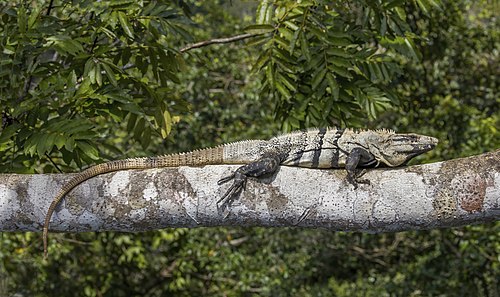
Green Iguana

Green Iguana

Iguana iguana

Least ConcernNear ThreatenedVulnerableEndangeredCritically Endangered
10–20% · With luck
overall probability at Chagres National Park
16 Verified records at Chagres National Park
November Best month highest sighting rate
☀️ Diurnal When it's active during daytime hours (6am–6pm)

The green iguana (Iguana iguana), also known as the American iguana or the common green iguana, is a large, arboreal, mostly herbivorous species of lizard of the genus Iguana. Usually, this animal is simply called the iguana. The green iguana ranges over a large geographic area; it is native from southern Brazil and Paraguay as far north as Mexico. It is highly invasive in many subtropical and tropical environments throughout the world. A herbivore, it has adapted significantly with regard to locomotion and osmoregulation as a result of its diet. It grows to 1.7 m (5.6 ft) in length from head to tail, although a few specimens have grown more than 2 m (6.6 ft) with bodyweights upward of 9 kg (20 lb). Wikipedia →

10–20% of wildlife watchers report a Green Iguana sighting in Chagres National Park, based on 16 days of visitor records from GBIF citizen-science data.

📅 Monthly Probability

<5
Jan
5–10
Feb
<5
Mar
10–20
Apr
10–20
May
5–10
Jun
20–30
Jul
20–30
Aug
10–20
Sep
5–10
Oct
30–40
Nov
10–20
Dec

☀️ When They're Spotted

Most active during daytime hours (6am–6pm) · across all parks (global)

☀️Diurnal
☀️🌙🌙12am6am12pm6pm12am

Global Distribution

Where this species is recorded worldwide. Restricted to human observations from 2019 onwards — the same kind of record and the same period the probabilities on this page are built from, so collar-tracking studies, camera-trap arrays and museum specimens are excluded. Around Santa Rosa that removes 5,924 GPS fixes from a handful of tagged jaguars.

where this species is recorded (GBIF density — it tracks where observers go, not how likely a sighting is)  ·  parks where it occurs — tap a pin for the sighting probability there

Parks Where Found

# Park Country Probability
1 Tortuguero National Park 🇨🇷 Costa Rica
70–80%
2 Tayrona National Natural Park 🇨🇴 Colombia
60–70%
3 Ostional Wildlife Refuge 🇨🇷 Costa Rica
60–70%
4 Palo Verde National Park 🇨🇷 Costa Rica
60–70%
5 Arrecifes de Cozumel National Park 🇲🇽 Mexico
50–60%
6 Las Baulas Marine National Park 🇨🇷 Costa Rica
50–60%
7 Soberanía National Park 🇵🇦 Panama
50–60%
8 Gandoca-Manzanillo Wildlife Refuge 🇨🇷 Costa Rica
50–60%
9 Parque Estadual Encontro das Águas 🇧🇷 Brazil
40–50%
10 Braulio Carrillo National Park 🇨🇷 Costa Rica
40–50%
11 Everglades National Park 🇺🇸 United States
40–50%
12 Machalilla National Park 🇪🇨 Ecuador
40–50%
13 Bastimentos Island National Marine Park 🇵🇦 Panama
40–50%
14 Cahuita National Park 🇨🇷 Costa Rica
40–50%
15 Cañón del Sumidero National Park 🇲🇽 Mexico
40–50%
16 Marino Ballena National Park 🇨🇷 Costa Rica
40–50%
17 Coiba National Park 🇵🇦 Panama
40–50%
18 Piedras Blancas National Park 🇨🇷 Costa Rica
40–50%
19 Manuel Antonio National Park 🇨🇷 Costa Rica
30–40%
20 Lago de Yojoa 🇭🇳 Honduras
30–40%
21 Main Ridge Forest Reserve 🇹🇹 Trinidad and Tobago
30–40%
22 Carara National Park 🇨🇷 Costa Rica
30–40%
23 Anavilhanas National Park 🇧🇷 Brazil
30–40%
24 Cabo Blanco Absolute Nature Reserve 🇨🇷 Costa Rica
30–40%
25 Henri Pittier National Park 🇻🇪 Venezuela
30–40%
26 Sierra de la Macarena National Park 🇨🇴 Colombia
30–40%
27 Caroni Swamp 🇹🇹 Trinidad and Tobago
20–30%
28 Parque Natural Metropolitano 🇵🇦 Panama
20–30%
29 Corcovado National Park 🇨🇷 Costa Rica
20–30%
30 Amacayacu National Natural Park 🇨🇴 Colombia
20–30%
31 Masaya Volcano National Park 🇳🇮 Nicaragua
20–30%
32 Arenal Volcano National Park 🇨🇷 Costa Rica
20–30%
33 Darién National Park 🇵🇦 Panama
20–30%
34 Montes Azules Biosphere Reserve 🇲🇽 Mexico
20–30%
35 La Amistad International Park (Panama) 🇵🇦 Panama
20–30%
36 Chagres National Park 🇵🇦 Panama
10–20%
37 Tenorio Volcano National Park 🇨🇷 Costa Rica
10–20%
38 Tapantí-Macizo de la Muerte National Park 🇨🇷 Costa Rica
10–20%
39 Cerro Azul Meámbar National Park 🇭🇳 Honduras
5–10%
40 Big Cypress National Preserve 🇺🇸 United States
5–10%
41 Monteverde Cloud Forest Reserve 🇨🇷 Costa Rica
<5%
42 Pico Bonito National Park 🇭🇳 Honduras
Insufficient data
43 San Lorenzo Protected Forest 🇵🇦 Panama
Insufficient data
44 Noel Kempff Mercado National Park 🇧🇴 Bolivia
Insufficient data
45 Utría National Natural Park 🇨🇴 Colombia
Insufficient data
46 Canaima National Park 🇻🇪 Venezuela
Insufficient data
47 Reserva de la Biosfera Mariposa Monarca 🇲🇽 Mexico
Insufficient data
48 Volcán Barú National Park 🇵🇦 Panama
Insufficient data
49 Cockscomb Basin Wildlife Sanctuary 🇧🇿 Belize
Insufficient data
50 Rincón de la Vieja National Park 🇨🇷 Costa Rica
Insufficient data
51 Farallones de Cali National Natural Park 🇨🇴 Colombia
Insufficient data
52 Santa Rosa National Park 🇨🇷 Costa Rica
Insufficient data
53 Chirripó National Park 🇨🇷 Costa Rica
Insufficient data
54 Bahía de Loreto National Park 🇲🇽 Mexico
Insufficient data
55 Khao Yai National Park 🇹🇭 Thailand
Insufficient data
56 Ría Lagartos Biosphere Reserve 🇲🇽 Mexico
Insufficient data
57 Tijuca National Park 🇧🇷 Brazil
Insufficient data
58 Cumbres de Monterrey National Park 🇲🇽 Mexico
Insufficient data

Quick answers

What are the chances of seeing a Green Iguana in Chagres National Park?

About 17% of wildlife watchers report a Green Iguana sighting in Chagres National Park, based on 16 days of visitor records from GBIF citizen-science data.

When is the best time to see Green Iguana in Chagres National Park?

November has the highest sighting rate for Green Iguana in Chagres National Park in our monthly data.

← Back to Chagres National Park